
On the Death of Mine Enemy
![[Screenshot from YouTube]](https://images.squarespace-cdn.com/content/v1/5d70f59aefca59000162e4e6/1572287567205-R4VRKE7I7FV4EV17SJD5/Screen+Shot+2019-10-28+at+10.01.13+AM.png)
[Screenshot from YouTube]
What should my reaction be when my enemy is killed?
Abu Bakr al-Baghdadi, as the leader of ISIS, was my enemy: I am a Westerner and a Christian. If he could have done so, he would have killed me and my family. I am relieved that he is dead.
I am not a pacifist; I think there are times in this world when violence in defense of the good is necessary, because there are some people who are so intent on evil that literally nothing but violence will stop them. Let me also say that although I am not a pacifist, I completely understand why some Christians believe that the Jesus way is absolute non-violence even in the face of evil. I do not come to the same conclusion as these Christians, but I understand their point-of-view, and perhaps I am wrong.
So, what should my reaction be when someone like Abu Bakr al-Baghdadi is killed? I think an initial sense of joy makes sense—this was a man who raped and tortured his way across the Middle East and inspired murder around the world, and this man will no longer be able to do these things. But, after an initial surge of joyful relief that a man like this will now face God’s justice, I think sadness should quickly follow. This was a bad man, but he was still a man, and we should be sad that he chose evil and sad that he did not repent before his violent end.
I think the death of an enemy should ultimately make us sad: sad that the world is the way it is, sad that people make the evil choices that they do, and sad that some people will not respond to anything but violence.
So, I am troubled by parts of what President Trump had to say to the nation announcing Mr. al-Baghdadi’s death: I think it was too graphic and triumphalist. It is a good thing that Mr. al-Baghdadi is dead, and it is definitely a victory for the United States. But, I think those same points could be made without remarks on his “crying, whimpering, screaming.” I do not think we should gloat publicly over the death of our enemies, because a sense of restraint is what should make us different from our enemies. Otherwise, where is the line between us and them? We know how ISIS would have behaved had they killed one of our leaders—like demons. We should behave as far from that as possible.
Once we become obsessed with victory over our enemies, we lose any sense of proportion or propriety. This is what hatred of an enemy will always do to us.
An example of what happens when you become obsessed with victory over your enemy is the Washington Post’s original headline announcing Mr. al-Baghdadi’s death. This has since been changed, but this is actually how the headline originally read:
![[Screenshot from Twitter.]](https://images.squarespace-cdn.com/content/v1/5d70f59aefca59000162e4e6/1572288839717-4D03U3BBAMD4QU56BQN0/Screen+Shot+2019-10-28+at+1.53.17+PM.png)
[Screenshot from Twitter.]
The Washington Post is so obsessed with defeating President Trump that the unnamed headline writer chose to call Mr. al-Baghdadi an “austere religious scholar,” presumably because the announcement of the raid and subsequent death would be a news cycle victory for the President. It is no secret that The Washington Post considers itself an enemy of President Trump.
This post is not about President Trump nor The Washington Post, however: it is about what can easily happen to each of us when defeat of our enemy becomes the most important thing in our lives.
Defeat of an enemy is a good thing, but it is not the ultimate thing. And when you exchange a good thing for the ultimate thing, it warps your soul.
I am taking these thoughts as a challenge to examine my own heart today. What about you?
Read Through the Gospel of John with Me

At Munger, we’ve been reading through the Gospels in 2019, and TODAY we begin the Fourth Gospel: the Gospel According to John. The readings are paced out on weekdays only, from Monday, October 28 through Tuesday, December 31. You should join me.
Sign Up Here
You can sign up here to receive a weekday email reminder and brief commentary from me, sent out M-F at 4:00 AM. (If you are currently on my Gospels 2019 mailing list, no need to do anything else.)
Update: be patient with today’s email—we’re having some technical difficulties.
More Info
At Munger, pick up a John Field Guide so you can just read along in the booklet.
(If you live out of town, email Rosemary, she’ll mail you a John booklet.)
If you would like to follow our schedule in your own Bible, you can download the reading schedule here.
On Wednesday, November 6, I’ll be teaching a 1 hour Bible study overview of the Gospel of John from 6:00-7:00 PM at Munger for 6th graders-old people. At the same time, there will be a study for elementary students. We’ll have free food trucks in the parking lot afterwards for anyone who wants to stay for dinner.
Let’s do this.
Forgiveness Is

On October 2, 2019, Brandt Jean delivered a victim impact statement at the trial of Amber Guyger. Ms. Guyger had just been convicted of the murder Mr. Jean’s older brother, Botham Jean. Apparently, Brandt Jean didn’t know cameras would record his statement; he thought the reporters had already left the courtroom. Here’s what this 18 year-old young man said to his brother’s killer:
If you truly are sorry, I know I can speak for myself, I forgive you. And I know if you go to God and ask him, he will forgive you.
And I don’t think anyone can say it — again I’m speaking for myself and not on behalf of my family — but I love you just like anyone else.
And I’m not going to say I hope you rot and die, just like my brother did, but I personally want the best for you. And I wasn’t going to ever say this in front of my family or anyone, but I don’t even want you to go to jail. I want the best for you, because I know that’s exactly what Botham would want you to do.
And the best would be: give your life to Christ.
I’m not going to say anything else. I think giving your life to Christ would be the best thing that Botham would want you to do.
Again, I love you as a person. And I don’t wish anything bad on you.[Turning and addressing the judge:]
I don’t know if this is possible, but can I give her a hug, please? Please?Brandt Jean, 2 October 2019
In a few short hours, that statement was being broadcast around the world.
The morning after Brandt Jean delivered his remarkable remarks on forgiveness, my son and I were listening to a sports talk radio station on the way to school. I was astounded to hear the hosts discuss forgiveness and mercy–not normal topics for a drive time sports talk show!– and even more astounded to see later that they weren’t the only ones provoked to so do by young Mr. Jean’s statement: Brandt Jean’s face and remarks were everywhere. That was a good thing: it’s not possible that we think too much about forgiveness. On the other hand, it was also clear to me that as a culture we don’t have a clear idea of what forgiveness is and what it isn’t. I hope the following helps clear up the picture.
Forgiveness Is a Scandal
Not everyone agreed with Mr. Jean’s decision to forgive Ms. Guyger, which shouldn’t be surprising: forgiveness is always scandalous. It does not fit within the world’s categories. An eye for an eye, that we understand, but forgiveness is troubling, and it always has been. On the cross, Jesus forgave the people who crucified him as he was being crucified. If that doesn’t trouble your sense of justice, you’re not thinking about it.
Forgiveness Is Never Deserved
The reason forgiveness is scandalous is because forgiveness is never deserved. By definition, you cannot be entitled to mercy–it is unmerited favor. No one owes someone else forgiveness. There are lots of times in life that we get into disagreements and misunderstandings, and a mark of maturity is your willingness to seek understanding and make peace with the other party. That is a good thing, but that is NOT forgiveness. Forgiveness involves actual wrongs and hurts, deliberately inflicted by the guilty on the innocent. When someone hurts you, what they deserve is for you to hurt them back–an eye for an eye. What they do NOT deserve is forgiveness.
Forgiveness Is Forgoing Your Right to Get Even
When you are wronged, you have an obligation to get even. Forgiveness is choosing to give up that obligation. I like how James MacDonald puts it in his book Come Home: A Call Back to Faith:
“Forgiveness Is the Decision to Release a Person from the Obligation that Resulted When He or She Injured You”
James MacDonald
I think it is the best definition of forgiveness I’ve ever read. When someone injures you, you have a decision to get even, or a decision to forgo your right to get even. Forgiveness is the latter.
Now let me stress that forgiveness and consequences are NOT incompatible with each other. Children need their parents to forgive them and they need their parents to give them consequences and boundaries so they can learn. In a civilized society the state prosecutes crimes so that the consequences for a crime are taken out of the hands of the victim. It is possible for a victim to forgive a criminal while the state sends that criminal to prison.
Whether and what consequences are appropriate in any particular case will depend on those circumstances; what does not depend on the circumstances is the option the injured party has to release the personal obligation to get even.
Forgiveness Is a Decision, Not An Emotion
If you choose to release your obligation to get even, it will be emotionally wrenching. However, your emotions are NOT a reliable guide to what’s true or what’s right, which is a good thing, because it will never feel good to forgive before you do it. You will not want to forgive; forgiveness is a decision of the will that we take in spite of our emotions.
Forgiveness is also very rarely a one-time decision. Instead, you will make the first decision to forgive, only to find the next morning you haven’t really released the obligation. And so you will make the decision again and again and again, and one day, by the grace of God, you will discover that the burden is really and truly gone.
Don’t be discouraged if you don’t feel like forgiving today or if it’s taken you a long time to forgive–that’s how it works for most of us most of the time.
Forgiveness Is Only About You
The good news is that the other party has absolutely nothing to do with your decision to forgive. It doesn’t matter if the person is remorseful and repentant or has confessed. This is because forgiveness is about you and your decision to release the obligation to get even. I find this idea freeing, because it means that the other person–even a very wicked person–doesn’t have any control over me. Forgiveness is my choice.
This means that it is possible to forgive someone who is far away from you or someone who will never be remorseful or even someone who is dead. Forgiveness is about you, not the other person.
This also means that you don’t have to tell the guilty party else when you are choosing to forgive him or her. Sometimes it’s not safe to tell someone face to face, and sometimes it is unwise. Reconciliation requires two parties, but forgiveness does not: it’s only about you.
Forgiveness is Risky
Even though forgiveness does not involve the other party, it is still risky. It’s risky because when we forgive, there is the possibility that the other party won’t ever know how much he or she hurt us and might even think he or she has gotten away with the wrong he or she did to us. Forgiveness will always feel risky, but rest assured: God is not mocked, and no one will escape justice forever.

Brandt Jean, Botham Jean’s younger brother, hugs former Dallas police officer Amber Guyger in court after saying he forgives her for killing his brother. Guyger received a 10-year prison sentence for murder.
Forgiveness Is the First Step Towards Reconciliation
Forgiveness is a means to an end, and that end is reconciliation. There cannot be reconciliation without forgiveness, though there can be forgiveness without reconciliation. Reconciliation involves both parties–the wrong and the wronged–whereas forgiveness only involves the wronged. God’s desire for us is not only forgiveness, but also reconciliation, and if reconciliation is ever going to occur, it will only occur because someone went first to forgive. Reconciliation is not promised and will often not happen in this life, but if it does, it will be as a result of forgiveness.
After Brandt Jean’s remarkable statement, the judge granted his remarkable request to hug Amber Guyger, and he and his brother’s killer hugged for a long time in the courtroom while an unidentified woman sobbed in the background. I don’t know what life holds for either person, but I am certain that that embrace would never have taken place had not that brave young man chosen first to forgive.
Forgiveness Is Necessary
We cannot live together without forgiveness. We wrong each other in great and small ways, and without forgiveness, we would live alienated, angry lives. A world in which we have the choice to forgive each other is the only world worth living in. More than that, however, forgiveness is commanded by Jesus in the Lord’s Prayer: “Forgive us our trespasses as we forgive those who trespass against us.” If you are a Christian, you have no option: it is vital that you forgive.
Forgiveness Is Freedom
Forgiveness is vital because forgiveness is freedom for… you. Forgiveness is the only way to be freed from the burden of vengeance and the obligation of getting even. Forgiveness is freedom because it is the deliberate choice to give over to God the responsibility for ultimate justice. Forgiveness is the freedom that comes from the faith that God will judge the world with righteousness, that he sees all the wrongs done to us and will make them right, and that we no longer need to bear the burden of doing so. Forgiveness is the freedom that comes when you take the burden you’ve been carrying ever since that person wronged you and giving it over to God.
So, let me press the issue: Whom do you need to forgive?
It will be difficult. It won’t be immediate. But it will be worth it.
For those who are interested, I go into more detail on forgiveness and on each of the above points in this sermon:
Ad Astra

I rarely find myself in agreement with the message of a Hollywood movie, but I’m all in on this one.
I played hooky today and saw the new movie Ad Astra in an empty, midday theater, which was appropriate, because it is a lonely, expansive film, which asks the perennial human question: What are you looking for? We are all looking for something, and usually that something is something out of reach, far away, ad astra.
The movie is set in “the near future” when humanity has developed the technology for deep space travel. (Not all the physics holds up to even my pedestrian knowledge, but it looks entirely believable all the way through.) Major Roy McBride (played by Brad Pitt) is sent on a top secret mission to find his father, lost near Neptune decades before. Since being left by his father as a boy, Roy has always been looking for something, and his search takes him literally to the stars.

So many of us live lives of quiet dissatisfaction, always looking for the next thing, all the while encouraged in our restlessness by multinational corporations who have learned how to monetize our searching.
If you had this car
If you had this woman
If you had this body
If you had this house
Then you would be satisfied.
But, it’s not true, is it? And so we keep looking ad astra and never think there might be something to the advice of Jesus to “consider the lilies.”
It is a beautiful prayer: “God, thou hast put salt on our lips that we might thirst for thee.” Our searching is, of course, ultimately a search for God. But there is a second order of restlessness that also keeps us from delighting in the simple gifts of God: the people at hand, the water we drink, the daily bread God provides. If we can’t take delight and satisfaction in these things, then no matter where we go, there we’ll be.
Like you, I’ve read the stories about Brad Pitt’s family chaos over the past few years: how he left his first wife, the movie star Jennifer Aniston, for the movie star Angelina Jolie, how they had a total of 6 adopted and natural children together, how his marriage fell apart, how he was charged with and then cleared of child abuse. I wonder, has all of that chaos caused him to reflect on what really matters? He plays his role with a wisdom that suggests he’s learned a lot of this the hard way, and is warning us of the danger of thinking that contentment lies ad astra, elsewhere, and not where we already are.
What does it profit a man to gain the whole world and lose his own soul?
What good is it to go to the stars if you haven’t learned to delight in the gifts of God already at hand?
Ad Astra (2019): recommended.
Munger Real Estate Miracle
If I hadn't seen this happen with my own eyes, I wouldn't believe it....
The Problem
Munger is a landlocked urban congregation in a neighborhood that is becoming more and more popular with young professionals and families, and it's obvious to everyone that if we are going to reach and serve our neighborhood, we're going to need more land. So, several years ago, we started praying about possibilities. But, the land around us was owned by many different parties--none of whom wanted to sell or even talk about selling--and valued at millions of dollars--which we didn't have.
And so, of January 1, 2017, this is the extent of the real estate Munger owned in Old East Dallas:

The Process
The first domino that needed to fall was the purchase of two boarding houses that abutted our property. But, the owner didn't live in Dallas, and she was completely unresponsive. One of our members ended up driving out into the country and taping a letter to her fence. She subsequently called him and told him she would never sell to us.
And then, months later, she called him again and said that she felt that God was telling her she ought to sell to the church.
Her price was $2 million, which we didn't have. Why so expensive? Well, the boarding houses brought in an annual income of $200,000, so the owner was selling a valuable income stream, even though we only wanted the dirt, not the buildings.
I stood before our congregation in October 2016 and told them we needed to raise $2 million in cash by Christmas. I had no idea if it were possible, but I knew it was the faithful thing to do.
Well, people stepped up and the Lord provided the $2 million! (I still can't believe it.) And so, in January 2017, we purchased the boarding houses in cash.
Repeat
Owning those boarding houses was the first step, but we still had a long way to go. It turned out, however, that the way things happened with the boarding houses was the way they took place with the other real estate parcels:
- We contacted owners who told us they would never sell;
- Subsequently, they changed their minds;
- But we didn't have the funds to buy;
- God provided the funds somehow;
- We gained the property.
Parcel after parcel, that's how it happened.
Munger Real Estate Miracle
And so here's what we own today, just 2.5 years later:

[A quick note on the image above: in the bottom left, there is a building partially colored with a yellow checkerboard pattern. That building contains 8 townhomes, 2 of which we own outright. Of the remaining 6 townhomes, the owner has given us a right of first refusal for the next 30 years.]
Side-by-Side Comparison
-
January 2017 -
June 2019
The Stats
In summary, we:
- Doubled our acreage;
- Gained $7 million of real estate, which we either purchased in cash (!) or were given outright by generous Mungarians, meaning we have no debt whatsoever;
- Prepared a master plan to set us up for the next 50 years.
And all of this happened in just 2.5 years!
When I say this is a miracle, I mean it literally: you can't explain it in human terms only.
What's Next?
I don't know why the Lord has been blessing us so richly, but I do know that we have a responsibility to be good stewards of what we've received. We have a really exciting master plan, and God willing, the potential is huge.
Expect great things!
P.S.
There is a small group of people without whose hard work and extravagant generosity this wouldn't have happened. You know who you are, and so does God. Thank you.
*****How to Subscribe to Updates from My Blog*****
If you sign up to receive my irregular updates, I’ll send you a white paper I’ve written called “The Simple Technique Anyone Can Immediately Use to Become a Better Communicator”.
I’m also blogging through the Gospels each weekday in 2019, and I have a separate mailing list for folks who only want to receive the Gospel posts. Subscribe here to receive a weekday update on that day’s Gospel reading. We begin the Gospel of Luke on July 7th--join us!

Once An Eagle

Seventy-five years ago today terrified young men jumped off bucking landing crafts into the roiling surf that broke on the ancient beaches of Normandy. Of the first to be shoved ashore, those that weren't immediately killed were drowned, and those that were neither killed nor drowned struggled ashore only to be killed in the wet sand, that soon became wet and with blood and not only water. A small number survived, and as the day went on their number increased. Seventy-five years later we look back on D-Day as a great victory. It was. But it was also war, and war is as it has always been: ugly, violent, wasteful, and in the midst of all that, an also an occasion for luminous heroism.
Today's anniversary has caused me to think of a great American book about war: Once An Eagle, by Anton Myrer.
Every war memoir I've ever read, and every combat veteran I've ever spoken to, always tells the same story about the men who make up an army:
- Some are staff officers who never come near the actual fighting and dying, and some of these have somehow attained senior rank despite never serving in actual combat;
- Some are staff officers who drop into combat roles to feather their records so as to attain future rank, and these are dangerous men, because they care only about promotion and will risk other men's lives for their own glory;
- Some are wicked men--both officers and enlisted--who enjoy violence and killing;
- Most are the ordinary enlisted men, terrified at the prospect of a violent death and also capable of extraordinary bravery and sacrifice on behalf of their friends;
- And some few are the good ones, the officers who do everything to serve the men under their commands, who often die, who are often passed over for promotion, and who will never be forgotten by the men they led.
This distribution shouldn't surprise us, because it's just the same as ordinary life. The difference is that in war, life and death is more immediate than it is for us in ordinary life.
Knowing the above and knowing that war is an inevitable part of human life, what is to be done?
Once An Eagle is unique among war books that I know of in that it's a novel about a sense of calling. The novel's hero is a Nebraskan named Sam Damon. Sam learns that war is mainly fought by ordinary, terrified men, who are often poorly led and made to die needless deaths, and so Sam feels a responsibility--a sense of calling--to offer himself to do what he can to serve the ordinary men who fight our wars.
The novel covers Sam's military career, beginning with World War I, then through the long wilderness years between the wars in lonely forts across the American West, the Philippines, and even mainland China. Then war comes again (as Sam always knew it would) with Pearl Harbor, and the fighting resumes.
Sam devotes himself to leading and serving the ordinary, terrified men under his command; there is almost something religious in the sacrifices he makes on their behalf. Once An Eagle is filled with scenes of brutality and waste and greed and stupidity, and also courage and sacrifice and the sort of quiet heroism that ordinary men perform when they must.
I said last year in a Father's Day post that I think every American man should read this book, and I stand by that statement today, as we remember the unimaginable terror and violence and heroism of D-Day, seventy-five years later.
Highly recommended.
★★★★★
Once An Eagle: A Novel, by Anton Myrer
Note on My Rating System
I use a 5 star system in my ratings to signify the following:
★★★★★ life-changing and unforgettable
★★★★ excellent
★★★ worth reading
★★ read other things first
★ not recommended
*****How to Subscribe to Updates from My Blog*****
If you sign up for my Andrew Forrest newsletter, I’ll send you a white paper I’ve written called “The Simple Technique Anyone Can Immediately Use to Become a Better Communicator”.
I’m also blogging through the Gospels each weekday in 2019,and I have a separate mailing list for folks who only want to receive the Gospel posts. Subscribe here to receive a weekday update on that day’s Gospel reading.
"Because He Lives"
Alleluia! Christ is Risen!
This is our 5th year (!) of hosting Easter services in Garrett Park, across the street from Munger. Easter is the best day of the year, and I feel so blessed to have been there this morning. I snuck onstage during our 9 AM service and took the following video while we were singing "Because He Lives." I know you can hear me singing, but I don't care: it's EASTER, and I'm going to sing at the top of my lungs.
I could watch this a thousand times and it would never NOT make me happy. (I particularly love the part 36 seconds in where the band drops out and you can hear the congregation singing.)
Thank you, Jesus.
Happy Easter, everyone!
*****How to Subscribe to Updates from My Blog*****
If you sign up for my Andrew Forrest newsletter, I’ll send you a white paper I’ve written called “The Simple Technique Anyone Can Immediately Use to Become a Better Communicator”.
I’m also blogging through the Gospels each weekday in 2019,and I have a separate mailing list for folks who only want to receive the Gospel posts. Subscribe here to receive a weekday update on that day’s Gospel reading.
Birthday Wish for Blood Donors
Today is my wife Elaine's birthday, and she's out for blood:
Two years ago, my wife Elaine needed 30 units of blood to save her life after the birth of our daughter. So for her birthday, she's asking you to consider being a blood donor.
Blood Drive Details
We're hosting a Blood Drive at Munger Place Church on Good Friday, April 19, 11a-5p (childcare 11a-1p).
Even if you don't live in Dallas, please consider being a blood donor in your city.
Give the lady what she wants!
*****How to Subscribe to Updates from My Blog*****
If you sign up for my Andrew Forrest newsletter, I’ll send you a white paper I’ve written called “The Simple Technique Anyone Can Immediately Use to Become a Better Communicator”.
I’m also blogging through the Gospels each weekday in 2019,and I have a separate mailing list for folks who only want to receive the Gospel posts. Subscribe here to receive a weekday update on that day’s Gospel reading.

Harvey Weinstein, Lori Loughlin, and the Grace of God

I got an email at 12:45 AM Christmas morning from someone who was very angry with my Christmas Eve sermon. (You can watch that sermon here.) In my sermon, I wondered aloud if we are becoming a culture without mercy--once people have sinned, can they ever find redemption?
I cited the extreme example of Harvey Weinstein and asked if even he can receive mercy. The person who sent me the angry email felt that I was excusing Mr. Weinstein's many sins that have caused harm to so many people. It shouldn't have to be said, but let me say it anyway: but I do not excuse, condone, or approve of any of the things Mr. Weinstein is said to have done. In fact, the very reason I used him as an example is precisely because his sins seem so particularly ugly.
Which brings me back to the question I was asking: Can Harvey Weinstein receive mercy? Can he receive redemption?
Our actions have consequences, and justice requires that people face those consequences. I don't think mercy and consequences are mutually exclusive; Mr. Weinstein should be prosecuted for his crimes and if he is found guilty, he should be sentenced accordingly. And, there should be boundaries in place that make it very difficult for him to hurt anyone ever again.
But what happens after that? If he repents, can he be redeemed?
I've been asking that same question recently with regard to Lori Loughlin and the other celebrities caught up in the college admissions cheating scandal.
What they did was wrong and they need to face the consequences.
But what happens after that?
It strikes me that it's when people are guilty and ashamed and despised--that that is exactly the time when they need to be welcomed at church. I have no idea if Lori Loughlin and her family have a church family, but I'd guess that they don't. Is there any church near them who will reach out? If they were to show up at a church, would they be gawked at? Would folks pull out their phones and post pics to social media?
It strikes me that it's when people are guilty and ashamed and despised--that that is exactly the time when they need to be welcomed at church. I have no idea if Lori Loughlin and her family have a church family, but I'd guess that they don't. Is there any church near them who will reach out? If they were to show up at a church, would they be gawked at? Would folks pull out their phones and post pics to social media?
Most of us are able to hide our sins or explain them away. We maintain plausible deniability and pretend.
But sometimes there is no hiding. Sometimes we are totally exposed. Sometimes the whole world knows.
It shouldn't need to be said, but let me say it anyway:
Jesus died for sinners. Not the respectable sinners only, but also the shameful, wicked, public ones. Jesus died for Harvey Weinstein. Jesus died for Lori Loughlin.
Is there anyone around them who will tell them?
Is there a church family who can teach them?
Is there a place they can go on Easter Sunday to hear the Good News?
*****How to Subscribe to Updates from My Blog*****
If you sign up for my Andrew Forrest newsletter, I’ll send you a white paper I’ve written called “The Simple Technique Anyone Can Immediately Use to Become a Better Communicator”.
I’m also blogging through the Gospels each weekday in 2019,and I have a separate mailing list for folks who only want to receive the Gospel posts. Subscribe here to receive a weekday update on that day’s Gospel reading.

"Maintenant, Elle Est Comme les Autres"

I know almost nothing about Charles de Gaulle, and so I was intrigued by the recent essay about him by Peter Hitchens in First Things: "A Certain Idea of France." One paragraph in particular struck me:
"De Gaulle possessed that great chivalrous virtue of being ready to walk unbowed and defiant in front of the powerful, while being gentle and even submissive to the defenseless and weak. He once became so angry with Churchill that he smashed a chair in his presence to emphasize his rage. Likewise, he defied Franklin Roosevelt over and over again. But he would go home after these battles to sing tender love songs to his daughter Anne, who suffered from Down syndrome. The tiny glimpses we have of this part of his life, obtained from the accidental observations of others, tear at the heart. His concern for Anne was entirely private and not at all feigned. After any long absence from home his first act was to rush up to her room. She died, aged twenty, in his arms. At her funeral, he comforted his wife Yvonne with the words, 'Maintenant, elle est comme les autres' ('Now, she is like the others'), which must be one of the most moving things said in the whole twentieth century."
Peter Hitchens, "A Certain Idea of France"
Now, she is like the others.
*****How to Subscribe to Updates from My Blog*****
If you sign up for my Andrew Forrest newsletter, I’ll send you a white paper I’ve written called “The Simple Technique Anyone Can Immediately Use to Become a Better Communicator”.
I’m also blogging through the Gospels each weekday in 2019,and I have a separate mailing list for folks who only want to receive the Gospel posts. Subscribe here to receive a weekday update on that day’s Gospel reading.

Father Elijah Follow-up

I know that some folks have been reading the apocalyptic novel Father Elijah, after I wrote recommending it last week. Three quick things as follow-up:
- Once you finish it, you should read the FAQs about Father Elijah that author Michael D. O'Brien has on his website. I think you'll find some of his answers helpful.
- Please shoot me an email or reply to this post and let me know what you thought of the book. My wife finished the novel late last night, and so she is now one of only two people I know in the entire world who have read Father Elijah. What are your thoughts?
- When's the last time you read a good, long novel? I'd say the time is right to read this one.
*****How to Subscribe to Updates from My Blog*****
If you sign up for my Andrew Forrest newsletter, I’ll send you a white paper I’ve written called “The Simple Technique Anyone Can Immediately Use to Become a Better Communicator”.
I’m also blogging through the Gospels each weekday in 2019,and I have a separate mailing list for folks who only want to receive the Gospel posts. Subscribe here to receive a weekday update on that day’s Gospel reading.

Letter from an African Boy

I was touched by this simple letter I just received from a boy my family sponsors in Kenya.
12/2/19
Dear Andrew
I hope that you are fine with your family members
Am also fine together with my family members
here in Kenya We are so happy to hear
that your doing well with your family there
I thank you for the Christmas gift you sent
to me. I was happy; together with my family
members, I went and bought clothes, food, and shoes
i weared them well and looked smart. Everybody looked me and
Everybody cheered me happily. Did you celebrated the Christm-
as? or you did not? If you celebrated I think you saw
it well.
Here in Kenya we celebrated it well. i dont know you
if you celebrated it well. I think the lord protected you
and i. I celebrated it well with out any problem
even you: I think so.
I will finish with a memory verse. Roman 10:18 So faith
comes from what is herd and what is herd comes by the
preaching of christ.
Your Faithfully
[signed]
May God bless you in great ways, little brother!
[The author is 13 years old, and we were connected with him through Compassion International. Compassion is a beautiful organization that I've been involved with for 15 years or so.]
*****How to Subscribe to Updates from My Blog*****
If you sign up for my Andrew Forrest newsletter, I’ll send you a white paper I’ve written called “The Simple Technique Anyone Can Immediately Use to Become a Better Communicator”.
I’m also blogging through the Gospels each weekday in 2019,and I have a separate mailing list for folks who only want to receive the Gospel posts. Subscribe here to receive a weekday update on that day’s Gospel reading.

Father Elijah

This 600 page apocalyptic novel has had a profound spiritual effect on me. Father Elijah: An Apocalypse is the story of Father Elijah Schafer—Polish Holocaust survivor, convert from Judaism, Carmelite Monk from a monastery in northern Israel—and is set in the near future. The author imagines what it would be like to be alive as the End Times approach. It’s worth quoting the author’s introduction at length:
“The reader will encounter here an apocalypse in the old literary sense, but one that was written in the light of Christian revelation. It is a speculation, a work of fiction. It does not attempt to predict certain details of the final Apocalypse so much as to ask how human personality would respond under conditions of intolerable tension, in a moral climate that grows steadily chillier, in a spiritual state of constantly shifting horizons. The near future holds for us many possible variations on the apocalyptic theme, some more dire than others. I have presented only one scenario. And yet, the central character is plunged into a dilemma that would face him in any apocalypse. He finds himself within the events that are unfolding, and thus he is faced with the problem of perception: how to see the hidden structure of his chaotic times, how to step outside it and to view it objectively while remaining within it as a participant, as an agent for the good….
[This book does not ] offer simplistic resolutions and false piety. It offers the Cross. It bears witness, I hope, to the ultimate victory of light.”from Father Elijah: An Apocalypse, by Michael D. O'Brien
Mr. O’Brien’s great skill is to make the unseen spiritual world accessible, and to make holiness attractive. After reading the novel, I find myself praying more and doing so more fervently.
I started Father Elijah in Israel a few weeks ago, and when I returned home, I found myself reading in bed, long after my family was asleep. As the novel approached its climax, I found myself unable to go to sleep, heart beating out of my chest.
And the last page of the novel? I was astounded when I read it.
Highly recommended.
★★★★★
Father Elijah: An Apocalypse, by Michael D. O'Brien
Note on My Rating System
I use a 5 star system in my ratings to signify the following:
★★★★★ life-changing and unforgettable
★★★★ excellent
★★★ worth reading
★★ read other things first
★ not recommended
*****How to Subscribe to Updates from My Blog*****
If you sign up for my Andrew Forrest newsletter, I’ll send you a white paper I’ve written called “The Simple Technique Anyone Can Immediately Use to Become a Better Communicator”.
I’m also blogging through the Gospels each weekday in 2019,and I have a separate mailing list for folks who only want to receive the Gospel posts. Subscribe here to receive a weekday update on that day’s Gospel reading.

The Spiritual World is Very Close

The spiritual world is very near--even now at hand--and all around, and yet it is also inaccessible to us by normal human actions. The spiritual world is invisible, but it is there. From time to time, God permits us to experience the spiritual world, but those times are rare this side of the grave, like seeing a snow leopard or Haley's Comet.
Peter, James, and John are given one of those rare glimpses of the spiritual world on the Mount of Transfiguration:
After six days Jesus took with him Peter, James and John the brother of James, and led them up a high mountain by themselves. There he was transfigured before them. His face shone like the sun, and his clothes became as white as the light. 3Just then there appeared before them Moses and Elijah, talking with Jesus.
Matthew 17:1-3
They see Jesus as he is in the spiritual world--glorious and radiant. When the Word became flesh and dwelt among us, he humbled himself and became as we are, but on the Mount of Transfiguration, his glory is unmasked.
Understand, though, that his glory is not in spite of his humiliation, but because of his humiliation:
Let the same mind be in you that was in Christ Jesus,
who, though he was in the form of God,
did not regard equality with God
as something to be exploited,
but emptied himself,
taking the form of a slave,
being born in human likeness.
And being found in human form,
he humbled himself
and became obedient to the point of death—
even death on a cross.
Therefore God also highly exalted him
and gave him the name
that is above every name,
so that at the name of Jesus
every knee should bend,
in heaven and on earth and under the earth,
and every tongue should confess
that Jesus Christ is Lord,
to the glory of God the Father.Philippians 2:5-11
Today's Scripture
How to Subscribe
I’m blogging through the Gospels in 2019. Subscribe here to receive a weekday update on that day’s Gospel reading. (There is also an option to subscribe to non-Gospels posts as well through my plain ole Andrew Forrest Newsletter.)

Suffering is the Way Forward

When Jesus begins to tell the disciples that he is going to Jerusalem to suffer and die, Peter pulls him aside and rebukes him.
Why?
Because Peter wants to believe that salvation is possible without suffering.
Jesus knows that suffering is inevitable, and I think the reason he reacts so strongly to Peter--"Get behind me, Satan!"--is precisely because the main temptation Jesus faces is the temptation to seek the Crown without the Cross. Jesus doesn't need Peter speaking the devil's words into his ear--the way of the cross is difficult enough.
Things haven't changed. Suffering is part of life, and the faithful will suffer. The Cross comes before the Crown. Good Friday comes before Easter Sunday.
But of course, if suffering is part of life--and I'm certain that it is--that means that you will suffer if you choose faithfulness, and you will suffer if you don't. Both the faithful and the unfaithful suffer. The question is, will we suffer because we are walking the Way of Jesus, or because we are trying to seek our own way? Both ways are difficult, but only one way leads to life.
Then Jesus said to his disciples, “Whoever wants to be my disciple must deny themselves and take up their cross and follow me. For whoever wants to save their life will lose it, but whoever loses their life for me will find it. 2What good will it be for someone to gain the whole world, yet forfeit their soul? Or what can anyone give in exchange for their soul?
Matthew 16:25-26
Which way are you walking today?
Today's Scripture
How to Subscribe
I’m blogging through the Gospels in 2019. Subscribe here to receive a weekday update on that day’s Gospel reading. (There is also an option to subscribe to non-Gospels posts as well through my plain ole Andrew Forrest Newsletter.)

The Rock

The church is not a charity. The church is not a social service agency. The church is not a fraternal club.
The church is a group of people called and centered around Peter's confessional claim at Caesarea Phillipi:
"You are the Messiah, the Son of the living God."
Matthew 16:16
Now, the church indeed does charitable things, serves the community, and draws people together. But each of those things derives from its identity; none of those things constitutes its identity. It is Jesus himself who gives the church its identity.
As long as we hold onto Peter's claim, the forces of evil and death itself will never prevail over Christ's church.
Herod is dead. Caesar is dead. Pilate is dead.
But Jesus is alive, and his church will never be defeated.
Amen.
As long as we hold onto Peter's claim, the forces of evil and even death itself will never prevail over Christ's church.
Some Quick Notes
- The English word "church" is a translation of a Greek word which means "called out." It was originally a political term that the early church co-opted.
- "Peter" is really just "Rock." Peter's given name was Simon--"Simeon"--but in this passage Jesus gives him his nickname and explains its significance--he will be the "rock" on which Jesus begins to build his church. (By the way, the Aramaic word for "rock" is "cephas," which is why Peter is sometimes called "Cephas" in the New Testament. It seems clear that Aramaic and not Greek was the first language of Jesus and the disciples--Greek was the language of commerce and politics.)
- Jesus's words to Peter are a bit confusing there at the end:
"I will give you the keys of the kingdom of heaven; whatever you bind on earth will be bound in heaven, and whatever you loose on earth will be loosed in heaven.”
Matthew 16:19
What does that stuff about the binding and loosing mean? I like how Grant Osbourne puts it:
"The church exists on earth but with a heavenly authority behind it. As the church takes the teaching of Jesus and lives it in this world both in terms of opening the doors of the kingdom to converts and opening the truths of the kingdom to the new messianic community, it does so with the authority and guidance of God."
Zondervan Exegetical Commentary on the New Testament: Matthew, pg. 630.
Today's Scripture
How to Subscribe
I’m blogging through the Gospels in 2019. Subscribe here to receive a weekday update on that day’s Gospel reading. (There is also an option to subscribe to non-Gospels posts as well through my plain ole Andrew Forrest Newsletter.)

The Sign of Jonah

Some years back, the Kimbell Art Museum in Fort Worth (TX) put on an exhibition called "Picturing the Bible: the Earliest Christian Art." I went and still remember being struck by one particular theme that emerged over and over in the artwork: Jonah!
Why Jonah? The early Church saw Jonah as a symbol for Christ:
- Jonah was in the belly of the fish for 3 days;
- Jesus was in the belly of the earth for 3 days.
- Jonah was vomited up from death to life;
- Jesus was vomited up from death to life.
- Etc.
Here is an example of the Jonah theme from the Roman Catacombs:

In today's passage, Jesus for the 2nd time in Matthew's Gospel refers to the "sign of Jonah." The Pharisees ask him for a sign, and this is what he says:
“When evening comes, you say, ‘It will be fair weather, for the sky is red,’ and in the morning, ‘Today it will be stormy, for the sky is red and overcast.’ You know how to interpret the appearance of the sky, but you cannot interpret the signs of the times. A wicked and adulterous generation looks for a sign, but none will be given it except the sign of Jonah.”
Matthew 16:2-4
"The Sign of Jonah." Of all the images he could have pulled from the Old Testament as a way of explaining his ministry, I would never have predicted that Jesus would pull from Jonah!
But Jesus is endlessly surprising, which is one of the things I really like about him.
How might Jesus surprise you today?
Today's Scripture
How to Subscribe
I’m blogging through the Gospels in 2019. Subscribe here to receive a weekday update on that day’s Gospel reading. (There is also an option to subscribe to non-Gospels posts as well through my plain ole Andrew Forrest Newsletter.)

Jesus and the Canaanite Woman

Here's the first question to ask of this difficult story: what is Matthew trying to tell us? The Gospels are not an exhaustive transcript of the events of the life of Jesus. Rather, they have been arranged selectively to make a theological point. For example, here is how John explicitly explains the purpose behind his Gospel:
Jesus performed many other signs in the presence of his disciples, which are not recorded in this book. But these are written that you may believe that Jesus is the Messiah, the Son of God, and that by believing you may have life in his name.... If every one of [the things Jesus did] were written down, I suppose that even the whole world would not have room for the books that would be written.
John 20:30-21, 21:25
Although Matthew doesn't have a statement of purpose as explicit as John, his point is fairly obvious: he wants us to believe in Jesus. So, the only reason to include the strange story of Jesus and the Canaanite woman must be because Matthew thinks it teaches us something important.
Context, Context, Context
Where does the story take place? Not in Israel proper, but in "the region of Tyre and Sidon." These are cities of Israel's traditional enemies, and to make sure we don't miss the point, Matthew makes it clear that it is a "Canaanite" woman who is pestering Jesus. The Canaanites were the violent idol-worshippers the Children of Israel fought when they entered the Promised Land. In other words, she is DEFINITELY NOT an Israelite.

This story takes place immediately after Jesus has had an argument with the Pharisees about what real faithfulness looks like. The Pharisees DEFINITELY ARE Israelites, but their hard-heartedness ultimately leads them to reject and crucify Jesus.
Contrast the Pharisees dismissal of Jesus with the Canaanite woman's persistent pursuit of Jesus. The chosen people REJECT the Messiah, whereas the Gentiles are eager to receive him.
"To the Jew First, then to the Greek"
Since Genesis 12, hundreds and hundreds and hundreds of years before the time of Jesus, the Lord's plan has been clear: to use the family of Abraham as the means by which he would save the entire world. The Apostle Paul explains this plan in Romans 1:16:
For I am not ashamed of the gospel, because it is the power of God that brings salvation to everyone who believes: first to the Jew, then to the Gentile.
Romans 1:16
Jesus is therefore explaining the rescue plan accurately when he says, "“I was sent only to the lost sheep of Israel" (Matthew 15:24). His ministry takes place in Israel, and is directed toward Israelites. But because the Jews reject him as Messiah, the gospel is then taken by Paul and others to the non-Jews, the "Greeks" or Gentiles.
The Jews traditionally viewed the Gentiles as unclean sinners, and no devout Jew would have anything to do with them. The Jews also called the Gentiles "dogs." Jesus is therefore using traditional Jewish ways of referring to Gentiles in this passage. He seems like a jerk, but I think he's setting up the disciples (and by extension, us) with the language he's using.
You Know the Tree by Its Fruit
His language seems harsh, but look at what Jesus does: he heals this pagan woman's daughter. Jesus has been telling us over and over again: you know the tree by its fruit. It's not words that matter, but actions. Though his words might seem harsh at first, he does in fact heal the little girl, just as he has previously healed the Centurion's slave. The ministry of Jesus is to the Jews, but here and with the Centurion there is foreshadowing: soon the gospel will be taken to the ends of the earth.
The Canaanite Woman is a Model for Faith
I think Matthew includes this story because he wants us to see the woman as a model for faith. She is persistent and single-minded: she needs what Jesus has, and she's not going to stop until she gets it.
I think Matthew includes this story because he wants us to see the woman as a model for faith. She is persistent and single-minded: she needs what Jesus has, and she's not going to stop until she gets it.
How can you imitate this unnamed woman today?
How to Subscribe
I’m blogging through the Gospels in 2019. Subscribe here to receive a weekday update on that day’s Gospel reading. (There is also an option to subscribe to non-Gospels posts as well through my plain ole Andrew Forrest Newsletter.)

How to Tell a Good Man from a Bad One

I know it's been a few weeks since I've sent out my daily posts on the Gospel readings, but I'm back from Israel and actually sleeping at night, so here we go again. The plan is for me to write a brief commentary on each day's reading that I will post on my blog and email out to those of you who are subscribed to my Gospels 2019 mailing list. In addition, I write other posts on all sorts of other topics from time to time, and I email those out to folks who are on my Andrew Forrest newsletter list. Subscribe!
Context is Key to Understanding the Gospels
One of the keys to understanding the Gospels is to pay attention to context:
- Where specifically is this story taking place?
- What happened beforehand? What happens after?
- Why did Matthew (or Mark, Luke, or John) place this story in this specific place?
Two Contrasting Banquets
Today's story of the feeding of the 5,000 is a great example of the importance of context, because it occurs immediately after Herod's beheading of John the Baptist at a drunken banquet. (I preached about that story yesterday.) After a banquet that culminates with a scene of horror --John's severed head is brought in on a platter--Matthew tells us the story of a very different kind of banquet on the green hillside overlooking the Sea of Galilee.
The crowds are gathered to see Jesus, and he has compassion on them. In addition to healing their diseases, Jesus presides over a remarkable miracle: everyone there is given plenty to eat.
How to Tell A Good Man from a Bad Man
Jesus has been telling us throughout the Gospel of Matthew: you know a tree by its fruit. A good tree produces good fruit, a bad tree produces bad fruit.
It's not what someone says that matters, it's what someone does. We know all we need to know about the difference between Herod and Jesus by comparing what happens at the two quite different banquets.
You know how to tell the difference between a good man and a bad man? Watch his actions, not his words.
Today's Scripture
How to Subscribe
I’m blogging through the Gospels in 2019. Subscribe here to receive a weekday update on that day’s Gospel reading. (There is also an option to subscribe to non-Gospels posts as well through my plain ole Andrew Forrest Newsletter.)

If I Forget Thee, O Jerusalem

From the Galilee we took the route to Jerusalem that Jesus would have taken: not the western route along the Mediterranean, via the Roman road, nor the central route, through Samaria, but the eastern route, along the Jordan River. When we arrived at The Dead Sea, we made the steep climb from Jericho through the Judean Desert, took the modern tunnel that cuts through one of the many hills that encircle Jerusalem, and when we came out, there it was.
People will tell you that the Grand Canyon is majestic, and probably every American has seen photos and videos of it. But the Grand Canyon itself, when you see it in person, is more astounding than the hype. I remember the first time I saw it it literally took my breath away.
Yosemite Valley is the same way. Many of us have seen pictures of it and heard how beautiful it is, but when you enter the tunnel through the heart of the mountain and emerge and see the valley before you--El Capitan and Half Dome and the surging waterfalls--it's better than you anticipated.
That's how it was for me when we came out of the tunnel through Mount Scopus, took the curve and saw Jerusalem across the Kidron valley. A place I'd heard about my entire life, a place I'd wanted to visit, only to get there and find that the actual experience of being there was better than I'd hoped.
"If I Forget Thee, O Jerusalem"
The psalmist wrote those famous words from Psalm 137 while in bitter exile in Babylon. My life in Dallas is not bitter, and I'm glad to be back home, but I understand the ancient poet's words. I have much more to say about my first visit to the Holy Land, but let this suffice for now: I loved every minute of being in the land of the Bible, and I never want to forget what it was like to see Jerusalem for the first time.
-

Jerusalem, from the Mount of Olives. -
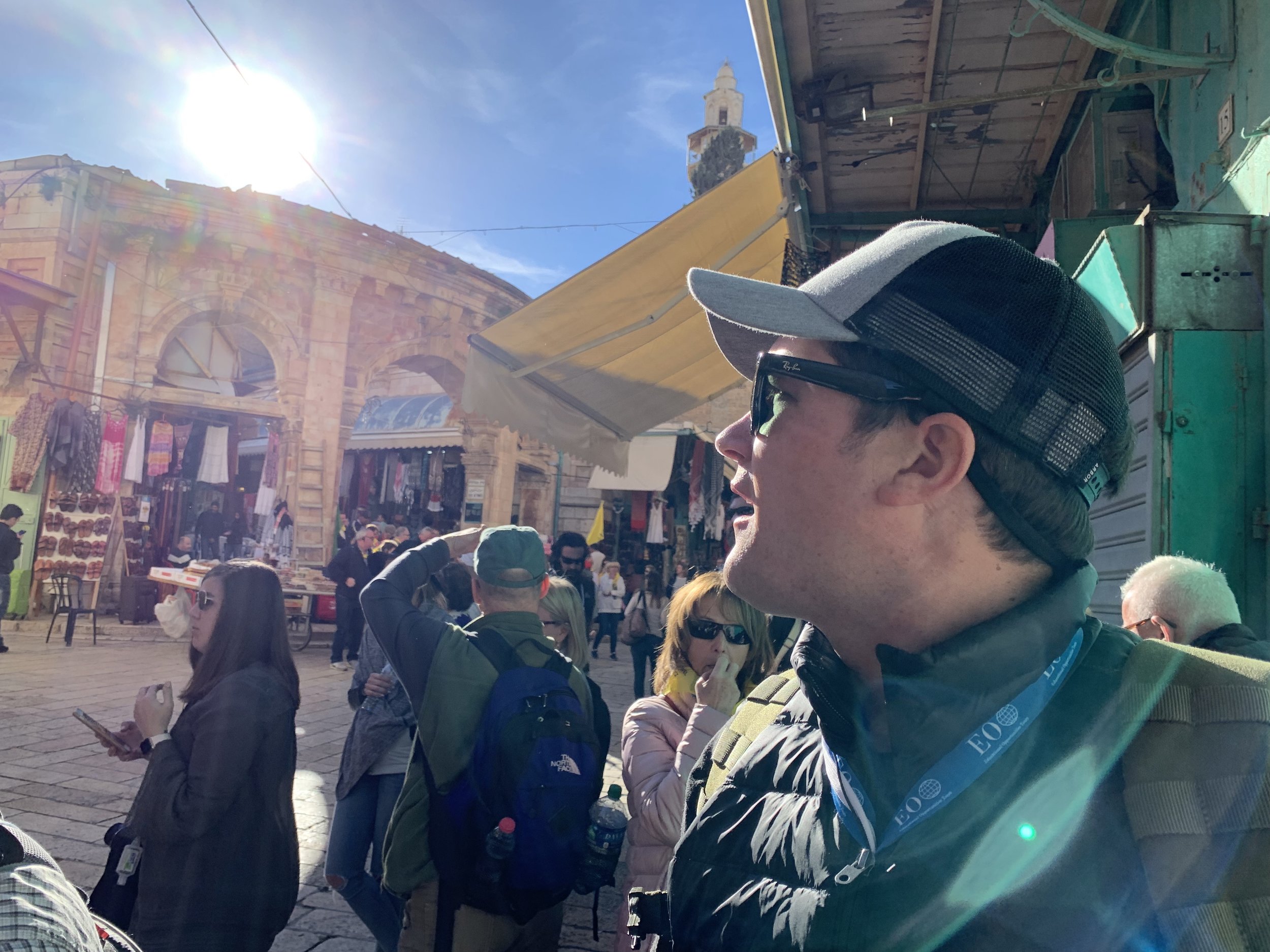
The Old City. -
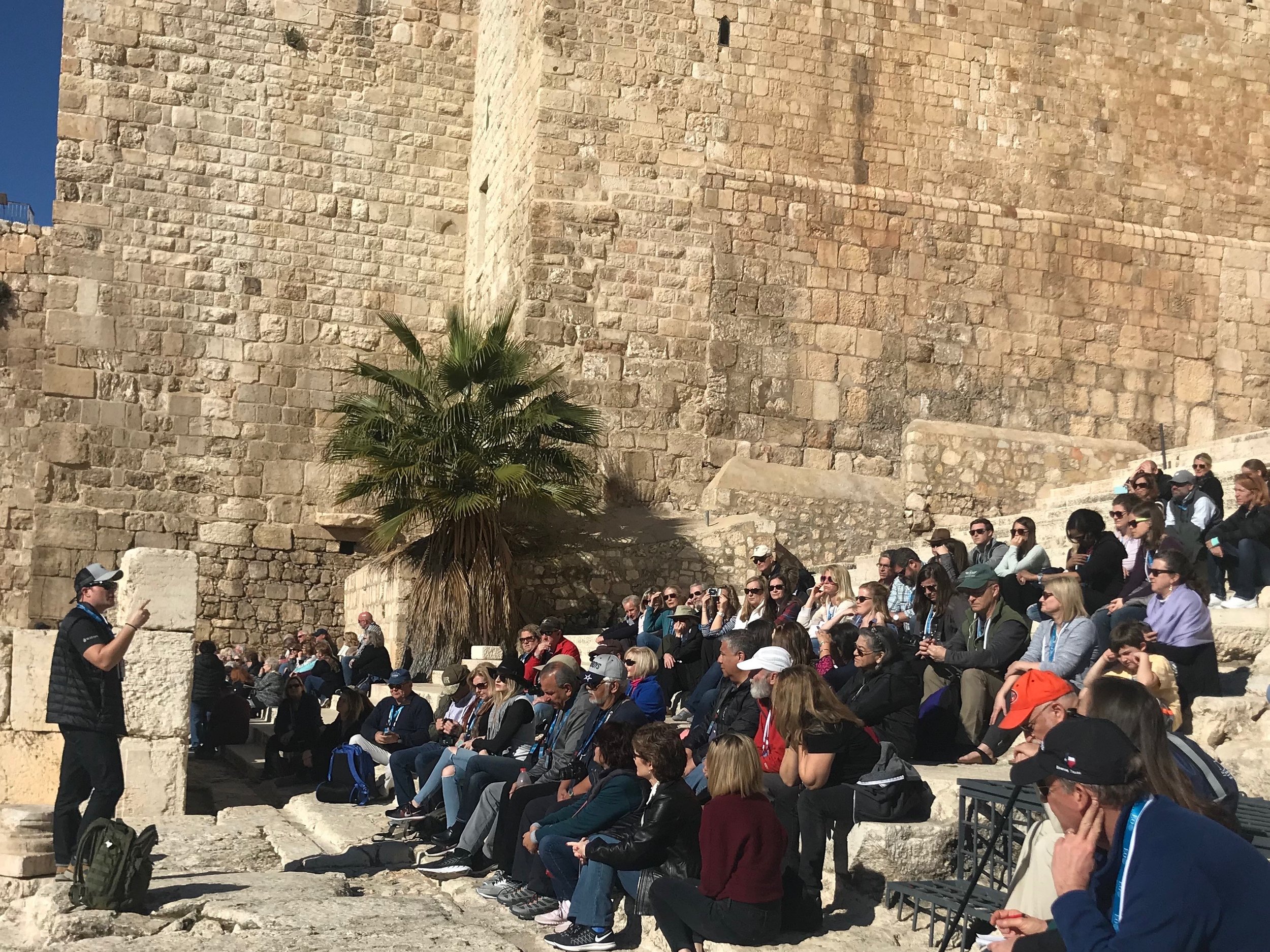
Leading a Bible study on the "Teaching Steps" at the southern end of the Temple. -
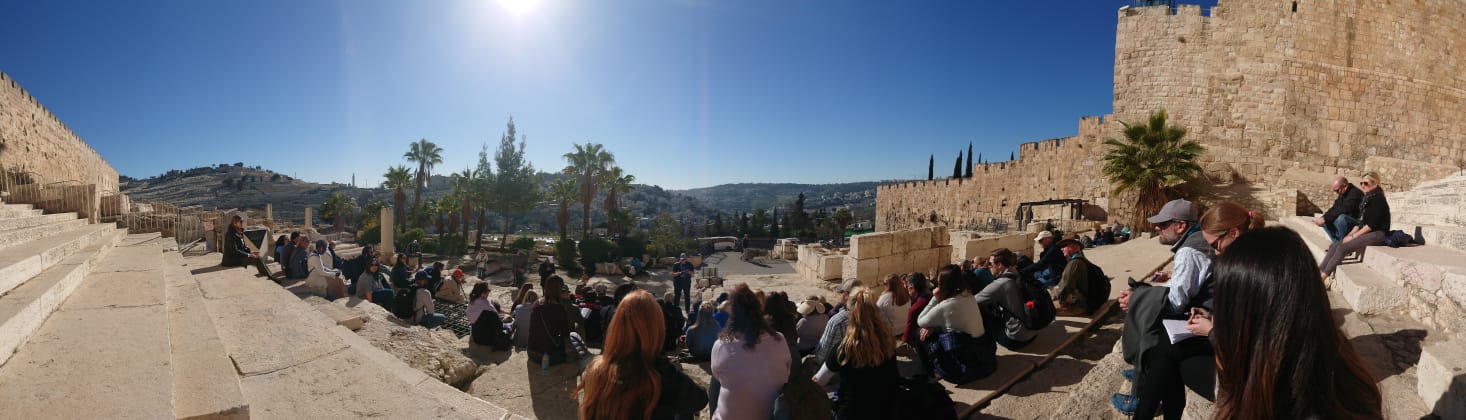
Jesus stood on these exact same steps! -

The top of the Temple Mount is now the Dome of the Rock, 3rd holiest site in Islam. -

I prayed and placed prayers in the Wailing Wall. -

We prayed in the Garden of Gethsemane -

An amazing recreation of Jerusalem in the time of Jesus.
How to Subscribe to Updates from My Blog
If you sign up for my Andrew Forrest newsletter, I’ll send you a white paper I’ve written called “The Simple Technique Anyone Can Immediately Use to Become a Better Communicator”.
I’m also blogging through the Gospels each weekday in 2019 (though I've not written anything while I was in Israel), and I have a separate mailing list for folks who only want to receive the Gospel posts. Subscribe here to receive a weekday update on that day’s Gospel reading.