

More on "Everything Worth Having"

Everything worth having comes with a cost. This is incontrovertibly true. But what happens when we become the kind of people who are no longer willing to pay the price? I think that's exactly what's happening to us: we modern Americans have become increasingly unable to deal with the inevitable difficulties of life. How did this happen, and what can we do about it?On February 18, I preached a sermon I entitled "Everything Worth Having Comes With a Cost." (The video is embedded below this paragraph; if you don't see it, refresh the page.) From time to time, there is more I want to say about a Sunday sermon, and so I will be running an occasional series here with extra thoughts and clarifications that I either didn't have time for on a Sunday, or thoughts and insights that didn't come to me until afterwards.
How Did We Get Here?
The increase in just the last 20 years of Americans?who require anti-anxiety medications just to get through the day is as good an indicator of our problem as anything else. More and more, we are people who are overwhelmed by daily life. There is a time and place for these sorts of medications, and surely they do a lot of good, but what I want to know is why the increase? Why are we consuming more and more medications to fight off anxiety and despair? Sure, Big Pharma has found these medications lucrative, and sure doctors might be more aware of our disorders now than in previous times, but these factors are not the cause of our anxiety, but a response to it. In any case,I am not concerned with our reliance on these medications so much as what that reliance indicates: we have a problem. We've become unable to deal with the inevitable difficulties of life. So, again, I want to know, Why? What's happening to us?Here's my theory: life has become too comfortable and convenient. One hundred years ago, just staying alive and feeding your family required more work that most of us have ever experienced. My family recently read a book together called?Little Britches:?Father and I were Ranchers, by Ralph Moody. It's a remembrance of a boy who moved with his family from New Hampshire to the plains of Colorado in the early 1900s. The amount of sheer hard work that the little boy--Ralph--undertakes just to help his family?survive is astounding. And this was in the 20th century! Describing life a generation or two before that, anyone who's ever read the?Little House?books by Laura Ingalls Wilder will have noticed the same thing: just how?hard life was for so many people in previous times. (The?Little House?books are well-known, of course, but I would highly recommend Ralph Moody's?Little Britches?to everyone reading this--whether you have little kids in your house or not. As a grown man, I still found it fascinating, moving, and edifying.)What I can't do, however, is complain that my kids are too comfortable. See,?it's not just that my children are growing up in comfort, but so did I, and so did my Boomer parents. I'd suspect that the last American generation to have to known daily drudgery was the one born before the Second World War. Since then, American life has become--through our wealth and especially our technological innovations--easy. By easy, I don't mean morally easy--more on that below--but that the daily process of being fed and clothed and sheltered has become easy. This ease is not restricted merely to the wealthy, either. I'm aware that there are millions of poor people in America who have none of the advantages that my wealth brings me; but I'm also aware that the poor people in America are not having to make their own clothes or grow their own crops or butcher their own meat or chop their own wood to heat up water. (This is not to say that it's not extremely difficult to be poor in America--I'm just making a point about how even the poor among us are exempt from the sort of tasks that virtually everyone--except perhaps the fantastically wealthy--who lived before 1940 would have encountered on a daily basis.) For several generations now, our daily lives have been made easier than any humans who have ever previously lived. But at what cost?Tim Wu wrote an excellent essay in?The New York Times?in which he argues that our eager embrace of convenience has become a form of tyranny over us. It's entitled, appropriated, "The Tyranny of Convenience," and if you've ever bought a book on Amazon instead of the brick-and-mortar bookstore you say you support will understand immediately "the powerful force shaping our individual lives" to which he refers:
In the developed nations of the 21st century, convenience that is, more efficient and easier ways of doing personal tasks has emerged as perhaps the most powerful force shaping our individual lives and our economies. This is particularly true in America, where, despite all the paeans to freedom and individuality, one sometimes wonders whether convenience is in fact the supreme value....But we err in presuming convenience is always good, for it has a complex relationship with other ideals that we hold dear. Though understood and promoted as an instrument of liberation, convenience has a dark side. With its promise of smooth, effortless efficiency, it threatens to erase the sort of struggles and challenges that help give meaning to life. Created to free us, it can become a constraint on what we are willing to do, and thus in a subtle way it can enslave us....
The dream of convenience is premised on the nightmare of physical work. But is physical work always a nightmare? Do we really want to be emancipated from all of it? Perhaps our humanity is sometimes expressed in inconvenient actions and time-consuming pursuits....
I do not want to deny that making things easier can serve us in important ways, giving us many choices (of restaurants, taxi services, open-source encyclopedias) where we used to have only a few or none. But being a person is only partly about having and exercising choices. It is also about how we face up to situations that are thrust upon us, about overcoming worthy challenges and finishing difficult tasks the struggles that help make us who we are. What happens to human experience when so many obstacles and impediments and requirements and preparations have been removed?
Today‘s cult of convenience fails to acknowledge that difficulty is a constitutive feature of human experience. Convenience is all destination and no journey. But climbing a mountain is different from taking the tram to the top, even if you end up at the same place. We are becoming people who care mainly or only about outcomes. We are at risk of making most of our life experiences a series of trolley rides. [My emphases.]
I'm grateful for modern medical care, and I don't want to have to take cold showers, but the truth is that all our modern life conveniences are having an effect on our character. See, when you are confronted every single day with inconvenient and uncomfortable tasks?that are necessary to life, you learn that difficulty is an inescapable part of life. You learn through experience that everything worth having comes with a cost. And then, when you face larger difficulties of life--the sort of difficulties that cannot be solved by technology, that is to say the moral difficulties that involve self-denial and selflessness and moral courage and strength in the face of pain and hope in the face of despair--you are more prepared the pay the price to overcome them.But us? We experience the big difficulties of life, the difficulties that cannot be eliminated by technological innovation, and we find them overwhelming. And so more and more of us lack the character to pay the price necessary to flourish in the world. I find this terrifying, because I find it in myself. For the Israelites, the generation that refused to pay the price to enter The Promised Land was condemned to wander in the desert and die before they ever got there. What about us? Since I believe it's true that everything worth having comes with a cost, our lack of fortitude will mean that there are lands flowing with milk and honey that we'll never enter, because we just can't stomach it. What will this mean for marriage and citizenship and difficult political questions? Instead of facing the hard things straight on, we'll medicate through media or medicine and try to ignore the fact that we're constantly busy but have little to show for our efforts. And this in turn will cause us more anxiety. So it will go.
What's to be done?
This is what I ran out of time to say in my sermon: there are two steps we need to take, as I see it. The first is for us to dare to question the cult of convenience. As Tim Wu points out, maybe some forms of inconvenience are actually good for us. When it comes to our children, it may actually be good for them to have to work harder than we did at that age. As for me, maybe I need to choose to do some of the things that I could pay a machine or a person to do for me, and maybe I should require my children to do some of those things, too. Maybe all the tools for convenience that we use should be more like hard painkillers--obviously necessary sometimes, but problematic if we rely on them all the time. If not, we'll become the moral equivalents of the obese, slippery humans in?Wall-E: unable to do anything necessary and difficult.[embed]https://www.youtube.com/watch?v=5kngspqvHa0[/embed]Of course it is impossible to remove oneself totally from modern conveniences, even if we wanted to do so (and I don't want to). But it may be that just small acts of inconvenience--waiting in line?without my phone?(God help me--how will I survive?!); walking when I could drive--will be helpful. That first step we each can begin to do immediately: question the cult of convenience, and act accordingly.But the second step is the exact opposite. See, the truth about us is that we're stuck. Not only are we stuck in the modern world, and not only can we not turn back the clock even if we wanted to (and we've seen enough post-apocalyptic scenes to know that the only way back lies through destruction), our problem is even deeper than that: the deepest price we need to pay we won't ever be able to pay, not because we?won't but because we?can't. We can't ultimately fix ourselves; we cannot perfect ourselves, we cannot save ourselves. Everything worth having comes with a cost, and Good News is that God has paid the price for us.What difference does the Gospel make here, practically?Mercy is receiving something you don't deserve, something you can't get on your own, something you can't earn. And so, in light of what we know about God's character since that first Easter, the second step to help us become stronger, is, paradoxically, to ask for help. To admit that we're weak.Everything worth having comes with a cost. But what happens when you've become afraid to pay it? What happens when you're afraid to do the hard but necessary thing at work, in your marriage, with your health, about your addictions, etc. Practically, what do you do? You ask for help. Literally. You ask God to help you. "Lord, I want to enter The Promised Land, but I'm afraid of what it will take to get there. I don't like difficultly and I hate suffering. Will you please help me?"And you know what? He always does.
Subscribe to my newsletter and I'll send you my brand-new e-bookThe Simple Technique Anyone Can Immediately Use To Become a Better Communicator.

"Annihilation"--Book Review

I finished the Jeff VanderMeer science-fiction/horror novel Annihilation last month; the movie opens this week. [No spoilers below, by the way.] I?d seen the trailer for the movie online and was intrigued by the BASED ON THE ACCLAIMED BEST-SELLING NOVEL? title that flashes across the screen, so I put the novel on hold at the library. (I?d not heard of it previously.) My verdict, now that I‘ve read it? If the movie Annihilation?is anything like the novel?Annihilation,?it will be STRANGE.The novel begins in medias res as a team of four women?each unidentified, except for her title: psychologist, anthropologist, surveyor, and our narrator the team biologist?begin to explore a wild coastal wilderness known as Area X. Area X is beyond a mysterious border that requires the women to have been hypnotized to pass through it; the team‘s mission is to research the area and report back to some mysterious agency called The Southern Reach. Almost immediately, the team stumbles across a mysterious underground tower,? the top of which begins at the earth‘s surface. The entrance leads to a spiral staircase that continues underground. The team explores the tower, and below ground, in the dark, they discover a long stream of words running along the wall. The string begins
Where lies the strangling fruit that came from the hand of the sinner I shall bring forth the seeds of the dead to share with the worms that?.etc.
The biologist comes close to the words and discovers that they are in fact a living organism or organisms, perhaps some type of fungus. They return to the surface, and strange things begin to happen.Or, at least, strange things are implied and occasionally shown. The strangeness of the novel slowly increases the more you read, because the characters in the midst of the strangeness don't seem to be overly bothered by it, which I take is the effect the author was going for: the very fact that everyone in Area X takes its increasing weirdness in stride is a clue to us that the entire situation is uncanny. We wonder, What‘s wrong with these women? Why is our narrator so matter-of-fact in describing a situation that is so utterly bizarre?The novel in fact is so bizarre that I finished it and had to ask myself, What was this about?Now, you should know that almost none of the scenes in the movie trailer is actually in the novel, but if you're planning on seeing it, expect it to be?weird. And let me know if you figure it out.

If I Could Have Any Billboard....

"If you could put any message on a billboard that millions of people would see, what would it be?" Tim Ferriss asks this of his podcast guests, and it's got me thinking: What would I want to say?Any message worth putting up would have to be one that folks wouldn't get elsewhere--why else go to all the trouble to get the billboard if you're not saying something interesting?So, here are some ideas that I don't think you'd see anywhere else.
Anything Worth Having Comes With a Cost
I talked about this billboard option earlier today in my Sunday sermon. I've been racking my brain, and I can't think of a single contrary example. Even things that are free to me still cost other people. The reason this is an important message is that it reminds us that when we face difficulty in learning Spanish or getting in shape or becoming sober or raising kids or being married, we should persevere: that the cost should be expected, and it's worth it.
Human Nature Doesn't Change
We think we are so advanced: we have the iPhone and the jumbo jet and the electric toothbrush. And, when it comes to our technology, we?are advanced. But, technological advances don't change human nature: our biggest problem is within, and it has been forever. How do we best?use all this technology? That's where wisdom is required. People have been the same everywhere: we're just as jealous, petty, brave, murderous, kind, etc., as we ever were. Technology doesn't change human nature, which means we need to learn the?exact same lessons of our ancestors: how to forgive, how to face our fears, how to have a flourishing family. Those lessons take time. All the technological advances in the world are useless at best and dangerous at worst if we don't take the time to learn from what the people before us learned. (This is why, by the way, the liberal arts are more important than ever. Sure, I have an iPhone, but that won't help me have a great marriage. I can fly around the world, but what does it take to raise my kids well? Homer and Dostoevsky, et al, have something to teach us here.)
Progress Is An Illusion
Human nature doesn't change (see above). So, it seems to me that the more advanced we get, the more ways we find to kill each other. Now, I'm grateful for our advances in medical technology, for example--I can't imagine living in a time without modern dentistry--but life is still difficult, and sin has a way of ruining everything. Take the internet, for example--it's brought lots of good things, but it has also made pornography available to children--something that no society has ever had to deal with before. I believe that we should always be striving to improve and develop our civilization, but I also believe that there are no problem-free situations, and that everything this side of heaven comes with unintended consequences. (This is what Tolkien called "the long defeat.") Neither human nature nor the world in general is perfectible (this fact is why I'm not a progressive), and though it is possible to make advances in this or that area, Progress will always be out of reach.
Catch a Common Theme?
I believe suffering and difficulty are part of life and that human nature is not perfectible. If ever there were a people who needed to be reminded of those inconvenient truths, it is modern Americans. That might sound harsh, but I actually find those messages to be helpful! When things get hard for me, I shouldn't be surprised--it's just the way life works. But, if the three billboards above seem too negative, here's one more:
In the End, Everything Will Be Okay; If It's Not Okay, Then It's Not the End
I think that message is basically the best news that's ever been given, and one you?can't hear too often. Keep going! What about you? What would your billboard say?

My One Word for 2018

All things seem possible in the early morning.
Nature's first green is gold
I love early morning, that time that seems like night until you look up and see that the sky is no longer black but has become that deep, rich blue color that only occurs there, then.I expect that was the color of Eden's firmament, early Adam's first morning.In the early morning, waking up and, for a brief moment, forgetting everything that you know except that it's a new day, that's the best time.After that, of course, remembering rushes in like water through a sluice-gate, and the day tumbles over itself. That moment doesn't return.But for that brief time, it's golden.
Early mornings are like a drop hanging on the end of a dropper, before it drips: all about potential, unrealized. And that's why I love them.
I wonder if Jesus loved early mornings for that reason, too. Before the Pharisees poked their fingers in his chest and asked him to justify himself, before he heard about the tragedy of the Tower of Siloam or how Pilate had profaned the sacrifice with the blood of those Galileans he'd killed, before John's disciples breathlessly told him about Herod's homocidal boasting before the dancing girl, I wonder: did Jesus savor those first few sinless minutes, before each day fell?
Very early in the morning, while it was still dark, Jesus got up, left the house and went off to a solitary place, where he prayed. (Mark 1:35)
Nothing gold can stay, though, can it?I memorized Robert Frost's little poem "Nothing Gold Can Stay" twenty years ago or so, and I've always thought he says it well:
Nothing Gold Can Stay
Nature‘s first green is gold,Her hardest hue to hold.Her early leaf‘s a flower;But only so an hour.Then leaf subsides to leaf.So Eden sank to grief,So dawn goes down to day.Nothing gold can stay.
Dawn, which began pregnant with potential, always goes down to day, and day always comes with disappointment at best and disaster at worst.
Hopkins knew this: that in time, everything becomes ruined:
And all is seared with trade; bleared, smeared with toil;
??? And wears man's smudge and shares man's smell: the soil
Is bare now, nor can foot feel, being shod.
I love early mornings, but early mornings are like light itself: you can't hold on to them. Mornings turn into days.And I don't need to tell you that days are difficult.
Days are difficult because that's how we make them--our dirty fingerprints are everywhere.Every morning is like Eden's first morning: pristine. But no day remains like that. Days comes with difficulty.
Yet days don't last either, do they? Days would have us believe that they are interminable, but we know by now that days irreversibly become evenings, and evenings inevitably become nights.And every night is followed by a new morning.
I think that's what I love most about mornings, how there is always another one coming. Regardless of how heavy and ugly was the day, at least we know that a new morning is on its way.Whoever it was who wrote Lamentations knew this about mornings:
The steadfast love of the Lord never ceases;his mercies never come to an end;they are new every morning.
? --Lamentations 3:22-23
C. S. Lewis says in his little book on the Psalms that Psalm 19 contains some of the finest poetry, not just in the entire Bible, but in all the world's literature. Here's how the Psalm opens:
The heavens declare the glory of God;And the firmament shows His handiwork.Day unto day utters speech,And night unto night reveals knowledge.There is no speech nor languageWhere their voice is not heard.Their line has gone out through all the earth,And their words to the end of the world.In them He has set a tabernacle for the sun,Which is like a bridegroom coming out of his chamber,And rejoices like a strong man to run its race.Its rising is from one end of heaven,And its circuit to the other end;And there is nothing hidden from its heat.--Psalm 19:1-6
It's a perfect image: the sun like a groom emerging from his tent on the morning of his wedding day, or like a runner who delights?in the very act of running itself. (One thinks of Usain Bolt, effortlessly striding down the Olympic track.)And it happens every morning.
So maybe God delights in mornings, too. Maybe the reason there's always another morning is because God himself can't wait to see another one. At least, that's what Chesterton thought:
The thing I mean can be seen, for instance, in children, when they find some game or joke that they specially enjoy. A child kicks his legs rhythmically through excess, not absence, of life. Because children have abounding vitality, because they are in spirit fierce and free, therefore they want things repeated and unchanged. They always say, "Do it again"; and the grown-up person does it again until he is nearly dead. For grown-up people are not strong enough to exult in monotony. But perhaps God is strong enough to exult in monotony.
It is possible that God says every morning, "Do it again" to the sun; and every evening, "Do it again" to the moon. It may not be automatic necessity that makes all daisies alike; it may be that God makes every daisy separately, but has never got tired of making them. It may be that He has the eternal appetite of infancy; for we have sinned and grown old, and our Father is younger than we. The repetition in Nature may not be a mere recurrence; it may be a theatrical encore.
? --G.K. Chesterton,?Orthodoxy
The ultimate morning, I guess, has to be Easter. It can't be a coincidence that the Resurrection happened "very early in the morning, while it was still dark." Of course the Spirit could have raised Jesus any time of the day or night, but here's what I think:Easter morning was?deliberate.
So, mornings to me are about the hope that God has a plan for me and for the world. Yes, days are difficult, but every morning is another promise that the Lord has something up his sleeve each new day. Yes, things are a mess, but God's not through with us yet.Hopkins, whom I quoted earlier, has perhaps my favorite description of mornings ever (it's at the end):
God's GrandeurThe world is charged with the grandeur of God.??? It will flame out, like shining from shook foil;??? It gathers to a greatness, like the ooze of oilCrushed. Why do men then now not reck his rod?Generations have trod, have trod, have trod;??? And all is seared with trade; bleared, smeared with toil;??? And wears man's smudge and shares man's smell: the soilIs bare now, nor can foot feel, being shod.And for all this, nature is never spent;??? There lives the dearest freshness deep down things;And though the last lights off the black West went??? Oh, morning, at the brown brink eastward, springsBecause the Holy Ghost over the bent??? World broods with warm breast and with ah! bright wings.
And though the last lights off the black West went??? Oh, morning, at the brown brink eastward, springsBecause the Holy Ghost over the bent??? World broods with warm breast and with ah! bright wings.
Yes. EXACTLY.
My one word for 2018 is?morning.
I'd love to have you sign up to receive my newsletter. If you don't like it, you can always unsubscribe, right?

My Bible Reading Plan for 2018

I'm going to read through the Bible in 2018, but if I'm going to make it beyond the first few pages, I know enough about myself to know that I need a good plan to follow. If I go to the gym without a plan, I'll fool around for 10 minutes and then say, "I've done enough for today--time to go home." I need to have a plan in place before?I go to the gym, and in the same way I need a plan to read the Bible, too. Otherwise, I just won't get anything done.So, here are 6 elements of my plan to read through the entire Bible in 2018.
1. The Read Scripture Plan
I'm using the READ SCRIPTURE reading plan put out by The Bible Project guys. It's roughly a Genesis to Revelation plan, though the order of some of the Old Testament books are rearranged to help you follow the narrative arc a bit better.
- The plan runs from January 1-December 24, 2018.
- Each day's reading will take about 15-20 minutes to complete.
- Every day there is 1 main reading (from either the Old Testament or New Testament, depending on where you are in the year).
- And every day there is 1 Psalm for devotional purposes.
This "Read Scripture" video from the Bible Project guys explains the plan.[embed]https://www.youtube.com/watch?v=7hUs4TXRuVk[/embed]
2. The Read Scripture App
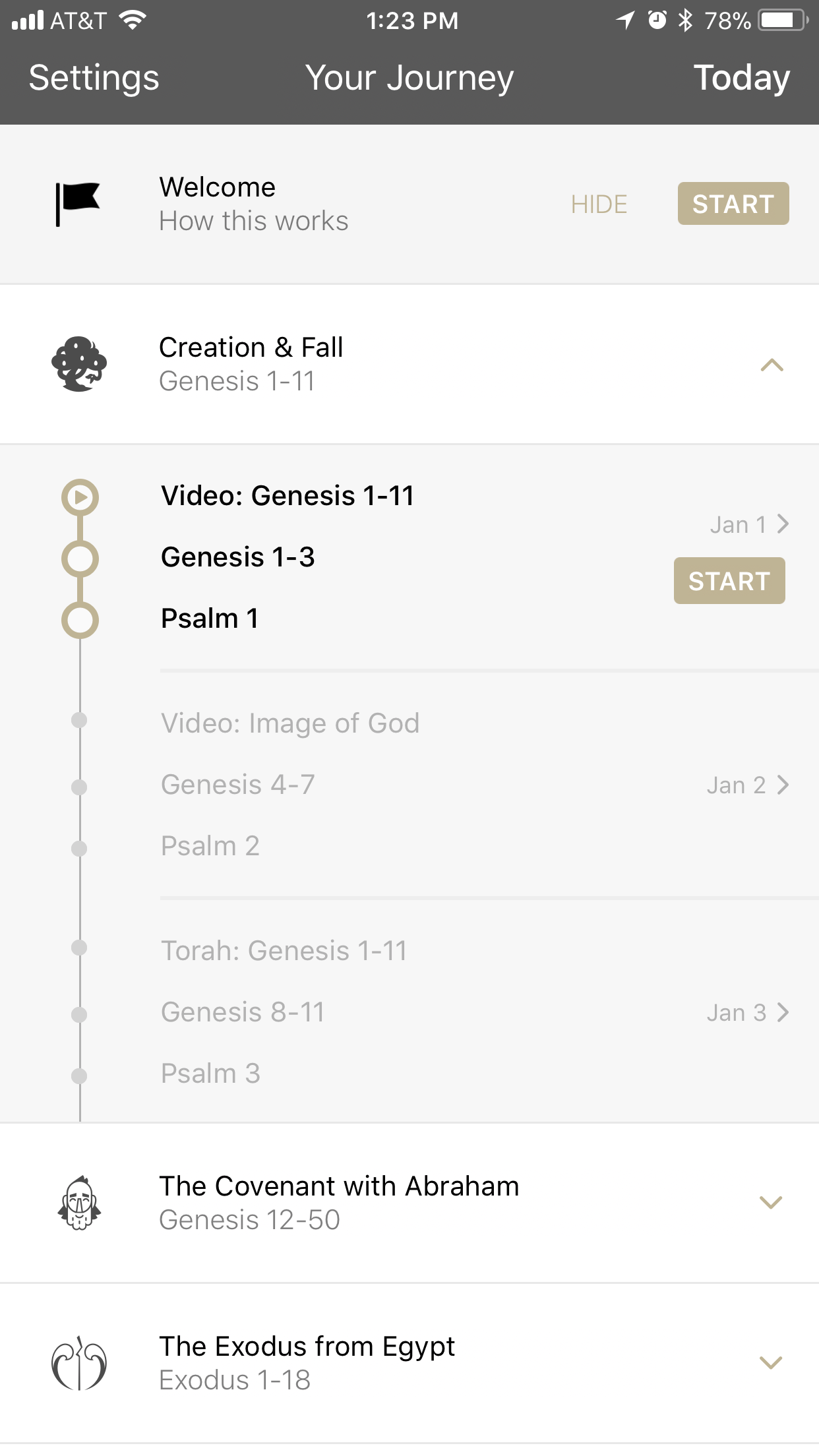
There is a free Read Scripture app that I'm going to use. I'm planning on doing my reading in my own Bible (more on that below), but I'm excited about also using the app to help me stay on track.
- The app includes each day's reading in a stripped-down format, so I can complete my reading right in the app, if I want.
- The app also includes a setting to include a daily reminder on my phone, and allows me to track my progress.. I'm the kind of person who likes checking things off each day, so I'll use the app for that purpose.
- As you can see in the screenshot below, the app also includes direct links to explanatory videos that are paired with a daily reading from time to time.
3. The Bible Project videos
The Read Scripture plan sometimes suggests explanatory videos to supplement a day's reading portion. (As I mentioned above, one of the benefits of the app is that it includes direct links to the videos, so you don't have to search on YouTube.) The videos the Bible Project guys are producing are REALLY GOOD. To cite one out of their dozens and dozens of really helpful videos, here is an overview of the Book of Leviticus:[embed]https://www.youtube.com/watch?v=WmvyrLXoQio[/embed]
4. A Brand-New Bible
Though I'm going to use the app to keep my on track, I'm planning on using my own Bible to complete the readings. (We're handing out bookmarks at church with a month's worth of readings at a time; here's a pdf of the January schedule.)
- I prefer to read on paper than in an app, when possible.
- I like to make notes, circle, underline, etc.
- This will be the same Bible I'll be preaching out of in 2018.
I used my Christmas money and bought a stunningly beautiful new Bible: a Cambridge Clarion Reference ESV in Black Goatskin. These Cambridge Bibles are $$$$, but they are absolutely the most beautiful books I have ever held.Here's how I decided on this particular Bible:
- I didn't need a study Bible;
- I wanted something relatively portable;
- I also wanted it big enough to have room for notes;
- I wanted cross-references (the little margin notes that tell you when the same quotation appears elsewhere in the Bible);
- I wanted an ESV translation, since it's not what I've used previously;
- And most importantly, I wanted a single-column text. All the other Bibles I own have double columns, but I thought it would be a good change to try a single column.
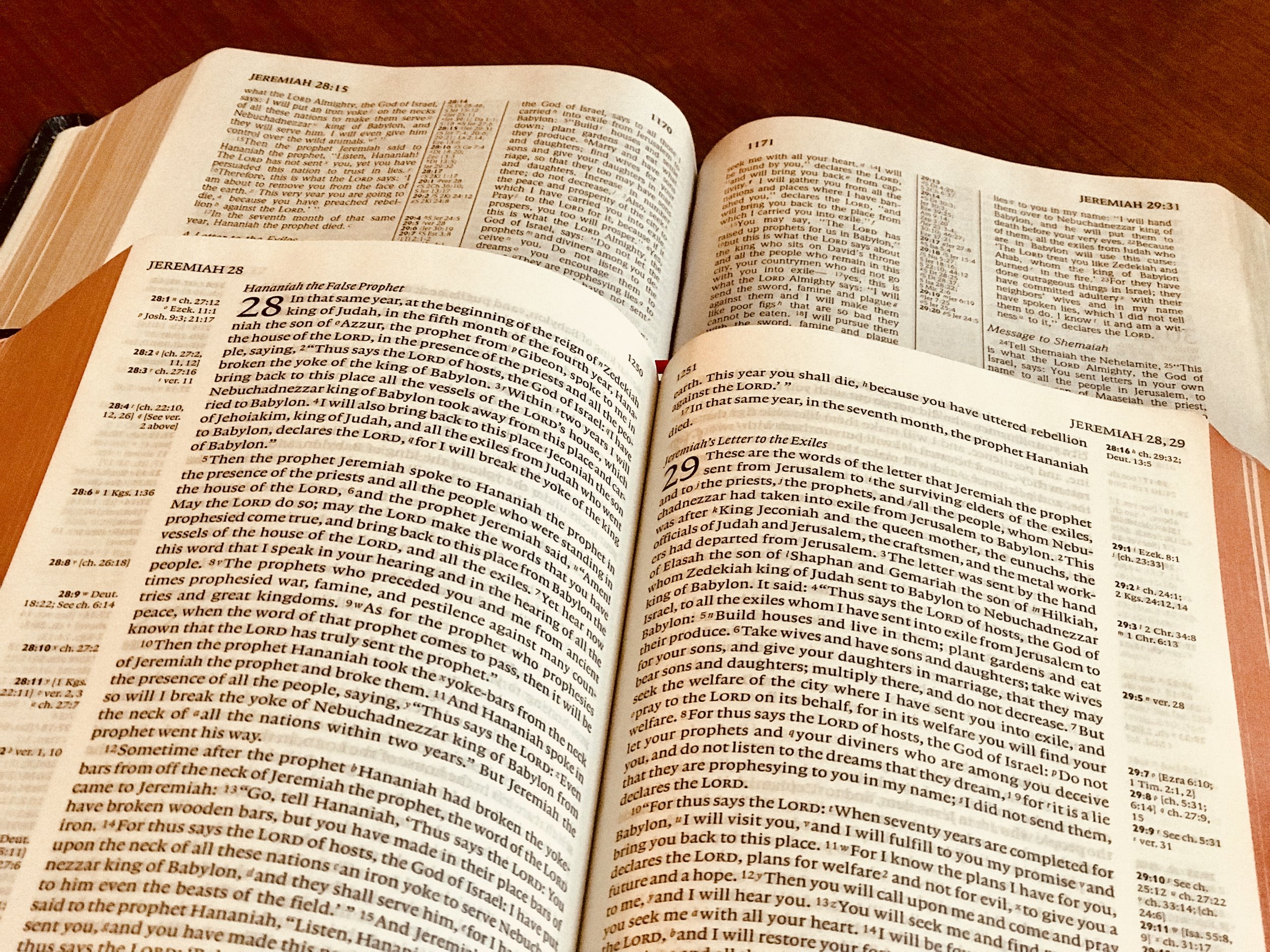 I eventually found myself deciding between two Bibles that met my criteria: the Cambridge Clarion ESV and the ESV Personal Reference Bible. Brad Schrum has a detailed and very helpful post with lots of pictures comparing the two. I decided on the Cambridge Clarion because it was slightly larger and I just liked the feel of it in my hand a bit more, but the ESV Personal Reference Bible was also a really good option. (If you're in the Dallas area, the bookstore at Dallas Theological Seminary has both editions, if you'd like to compare them.)
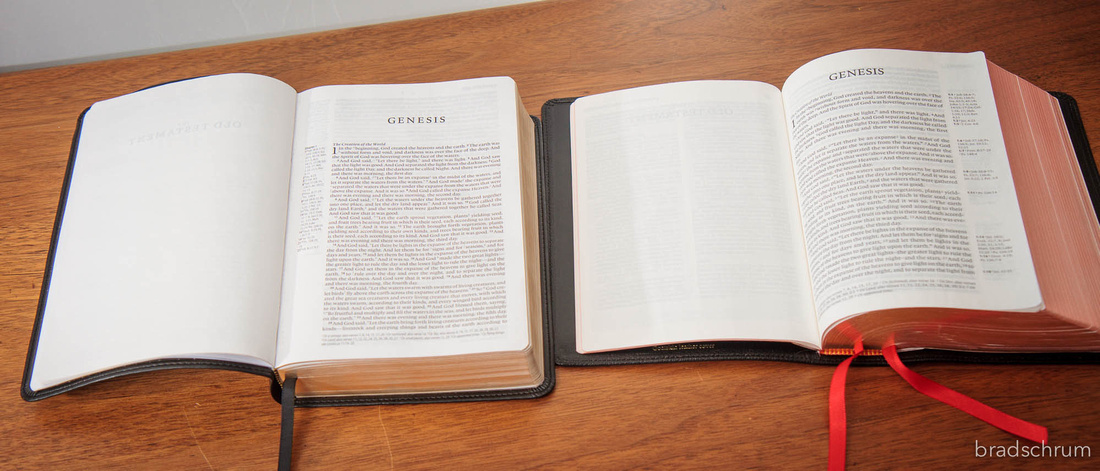 If you are interested in getting a new Bible for 2018, here are two others that I've used personally for years:For a good study Bible, try The NIV Study Bible;For a nice thin Bible, try the NRSV Thinline.
5. A Bible Blog
Both on this site and on our church's Bible blog, I'll be adding thoughts from my reading. (On the church blog, my colleague Amanda will have notes for every single day of readings!) Occasional blogging will help me stay engaged with the reading.
6. The Bible Project newsletter
The Bible Project guys have a weekly newsletter than tracks along with the Read Scripture plan, offering a recap of the previous week and an overview of the coming week. I'm going to sign up on January 1. Go here to sign up; scroll down until you see the picture below. The newsletter is just one more reminder to help me stay on track--it's a marathon, not a sprint, you know? So, that's my plan to read through the Bible in 2018.I'll let you know how it goes....
All the Cool Kids are Meditating, Man

I was just listening to the Brian Koppelman interview on Tim Ferriss's?Tribe of Mentors podcast, when one of Koppelman's answers struck me. The?Tribe of Mentors podcast is billed as "short life advice from the best of the best," and in it Ferriss asks his guests a series of standard questions, in a much shorter format than on his more well-known?The?Tim Ferriss Show podcast. One of the standard questions (a really good one) is:In the last five years what new belief, behavior, or habit has most improved your life?Here is Brian Koppelman's answer (beginning at 10:52 in the podcast):
"I know many of Tim's guests say this, and the answer is: meditation. For me, I do transcendental meditation, and I do it every day for twenty minutes, two times...first when I wake up in the morning, and then around 3, or 4, or 5, or 6 in the afternoon. And what I have found is that doing this mediation--taking this time--has drastically decreased the physical manifestations of anxiety and it has given me far more clarity and far more peace."
Some quick thoughts:
- ?He's right: many of Tim Ferriss's guests on this podcast and on the?Tim Ferriss Show talk about meditation. These folks often tend to be Silicon Valley/Hollywood/Venture Capitalist types, and they often mention how meditation has been a helpful practice to them.
- Because these folks are Silicon Valley/Hollywood/Venture Capitalist types--"California" in mindset, if not location--their practice of mediation tends to be "spiritual and not religious" in a New Age vein.
- It shouldn't be surprising that spending time quieting the mind and the soul brings helpful benefits. This shouldn't surprise us because people have known this for literally thousands of years, in every culture that I know of.
- It's almost as if we were created a certain way, and certain practices--independent of time and place, across all cultures and centuries--just produce good things in people's lives....
- Maybe human nature isn't plastic; maybe wisdom is not making yourself what you want to be, but rather making yourself fit the world.
- If the same folks on Tim Ferriss's podcasts had kept saying "prayer" instead of "meditation," they wouldn't seem nearly as cool, would they? Prayer is boring; meditation is cool.
- We're a culture that's forgotten what we used to know, and so we grab various life-giving practices out of the heap, but because we've forgotten what we used to know (like the folks in the Foundation in the Isaac Asimov novels), we're not able to use them to their full benefit.
- I recently heard Robert Barron say something interesting about prayer:
"Please don't think of prayer as something that God needs: God doesn't need your prayer, doesn't need my prayer. It's not like we're in this sort of pagan thing, where 'unless I get this much done, God's not going to do something'--don't think of it that way; he's not a 'pasha' that we're trying to impress with our supplications--prayer is for you, prayer's good for you, it's not good for God. God loves it because it makes you better and happier. It's not for God's sake, it's for your sake."
- The difference between Christian prayer and meditation seems to me to lie primarily in what you believe about ultimate reality: meditation is about quieting your heart and mind so you can experience the inner peace that comes from becoming more in tune with Reality, whereas prayer in the way and name of Jesus is about a relationship with the Person behind all reality. In the Christian tradition (and Jewish tradition, for that matter), Reality is not impersonal at all.
- The unique insight of the gospel is that Reality is a Person, and he's made himself known to us in the manger.
- Christians believe that God is Love. That beautiful idea is popular, but think about it: love requires personhood--love cannot be impersonal. Meditation is a good thing, but I don't think it can lead to love in the same way that prayer can, because prayer is about coming to know the source of Love itself, and his name is the LORD.
Anyway, it just struck me that many of the world-class performers that Tim Ferriss has interviewed have mentioned mediation. (Though I don't think I've ever heard a single one of them mention prayer.)

Nine Months

Nine months ago today, our baby daughter was born and my wife coded afterwards, an event which caused her to be hospitalized twice in the ICU and to undergo emergency, life-saving, life-altering surgery.This past Sunday was Christmas Commitment Sunday at our church. It's like our 21st century urban version of what used to be called Harvest Sunday in rural, agricultural churches: we thank God for his provision toward us in the 12 months past, and ask for his protection and provision in the year to come. Folks come forward and kneel and make a gift to finish strong in their current year giving toward the church, and make a commitment to give back a portion of God's blessings in the year to come. It's a powerful moment to see hundreds of households come forward and kneel and pray.When it was our family's turn, all four of us knelt and prayed and praised the Lord for his mercy toward our family these past 12 months and desperately asked God to be with us in the next 12 months. I find that I pray for God to protect us and prosper us almost constantly now; I am under no illusions regarding my utter dependence on the grace of God.The day before we were kneeling at the rail, we'd picked out a Christmas tree and were decorating it: my wife--completely healed--perched on a ladder stringing lights, and our little baby chirping and squeaking and scuttling underfoot like a some kind of huge, curious, terrestrial crab.As I look back over these past 12 months, I am overwhelmed: God has been‘so good?to us.A few weeks ago, Elaine and I made a brief video about some things we learned while she was in the hospital. (I've posted the video below.) Afterwards, of course, we thought of things we'd wished we said or said in a different way, and we share these thoughts humbly, knowing that this is our story, and your stories are different. Even so, we've seen the faithfulness of God firsthand and we feel as if we're supposed to tell other people about it.One day, of course, death will come for one or both us us, and for everyone we love. Maybe I will die first and leave Elaine behind, or maybe she will die first and leave me behind. But, even when that day comes, God is faithful, and Jesus is risen, so the words the angels shared with the shepherds are still meant for us today:Do not be afraid.[embed]https://vimeo.com/246001538[/embed]

5 Ways to Be Thankful (Even When You Don't Feel Like It)

How do we give thanks even when we don‘t feel like it?Christians are supposed to be thankful in every situation, which sounds nice on paper but is much harder to live out.Still, not only should we give thanks in all circumstances, the Bible promises that it‘s actually possible. Here are five simple suggestions that should help you and me give thanks, especially when we don‘t feel like we have anything to be grateful for.
1. Give thanks because God is good, period.
The Lord is good, always and everywhere?it‘s part of his nature. So, it‘s always appropriate to give thanks to God just because of who he is.
- The Lord caused the sun to rise this morning, just because he is good.
- The Lord gave you life, just because he is good.
- The Lord created giraffes, just because he is good.
We cheer when the slugger hits a home run because home runs should be cheered.We smile at babies because babies should be smiled at.We are in awe when we stand at the Grand Canyon because the Grand Canyon is awesome in the full sense of the word.And we give thanks to God just because of who God is. Period. ?Give thanks to the Lord, for he is good; his love endures forever. (Psalm 118:1.)
2. Give thanks that it‘s not as bad as it could be.
In every circumstance, it could always be worse. This fact is brought home to me every time I visit the Children‘s Hospital?I always leave thinking, Compared to what some of these people are going through, I don‘t have any? Whatever you think your problems are, it could be worse.
- If you have cancer, give thanks that it‘s not a worse form of cancer.
- If you?re married but can‘t have children, give thanks that you?re married.
- If you?re single and want to be married, give thanks that you?re not in a bad marriage.
Your circumstances may be bad, but praise God they aren‘t worse.
3. Give thanks that out of a bad situation, something good can come.
I'm writing this on the plane after being at a family funeral all week. Death is not good, but the fact that a funeral brings family together is a good thing; it‘s something to be thankful for. A good question to ask is, What does this now make possible??
- Your time in the hospital gives you time to pray that you didn‘t have before.
- Your recovery allows you to experience the kindness of friends.
- Your financial struggles give you the opportunity to trust God for your daily bread.
- Your suffering makes you more empathetic toward others.
Many times what we think is a bad turn of events either makes something good possible, or brings about an unexpected blessing. Give thanks for that. ?What you intended for evil, God intended for good. (Genesis 50:20?Joseph speaking to his brothers years after they sold him into slavery.) 4. Give thanks that your situation allows you to experience a small taste of Christ‘s suffering.Christ not only physically suffered, but he was also humiliated and betrayed. The New Testament writers continually tell us that our suffering gives us the opportunity to be more unified with Christ.
- If people are lying and saying ugly things about you, they did that to Jesus.
- If you are in acute physical pain, so was Jesus.
- If you feel totally alone, so did Jesus.
No one wants to suffer, but in suffering we have the opportunity to draw closer to Christ in ways that would not be possible if everything were okay. That‘s something to be grateful for. ?For he has graciously granted you the privilege not only of believing in Christ, but of suffering for him as well. (Philippians 1:29.)
5. Give thanks that The End is good.
The Bible ends with a future promise that everything sad will become untrue,? to quote Sam Gamgee. (See Revelation 21.) The Resurrection of Jesus is the sign of what God is going to do with all of history?he will redeem all that he allows? in Jim Denison‘s great phrase. So, even when your circumstances seem hopeless?and each of us is going to die, sooner or later?we Christians can give thanks that God is ultimately going make everything new. This fact enables Christians to give thanks even in the midst of death.?He will wipe every tear from their eyes.Death will be no more;mourning and crying and pain will be no more,for the first things have passed away. (Revelation 21:4.)Giving thanks when you don‘t feel like it is a mark of holiness?of spiritual maturity?and it is very difficult. But, as with other difficult things, we get better with practice, through the grace of God. So, start small. And start right away. 

"The Media and the Massacre"
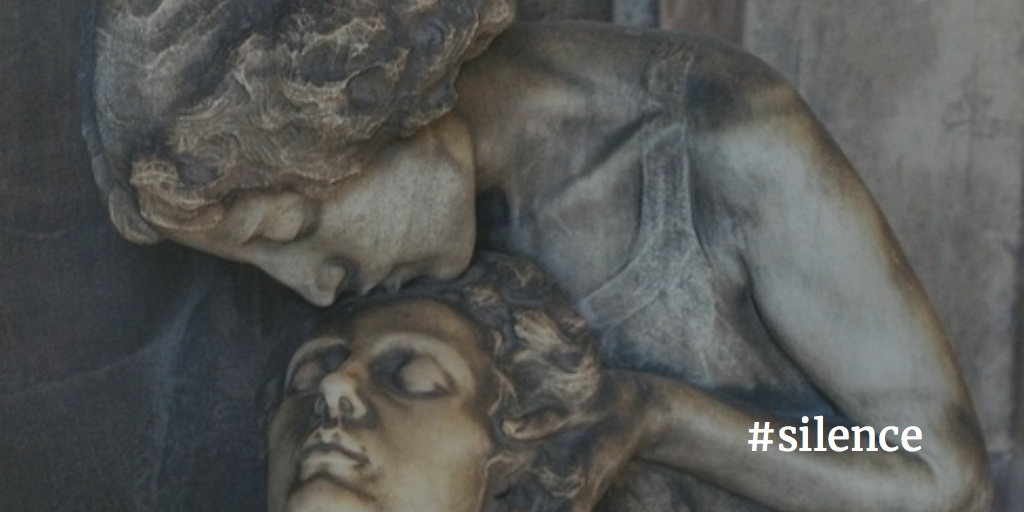
I don't know what to say about the massacre overnight in Las Vegas. Probably the best thing is to say nothing, to resist the urge to explain, to sit in silence and actually pray, rather than just tweeting that worse-than-useless phrase "thoughts and prayers." This morning, however, I came across a brief essay that I actually found helpful in light of today's evil news, an essay that Andy Crouch wrote in 2012 after the Newtown massacre at Sandy Hook Elementary called?"The Media and the Massacre":
The most basic lesson for those who would comfort the victims of tragedy is that the first, best response to tragedy is presence, and often the best form of presence is silence. The grieving, the sick, and the dying sometimes need our words, sometimes need our touch, but almost always they need our presence. And there is no contradiction between presence and silence in the embodied life for which we were all created, to which we are all called, into which God himself entered. Bodies can be present without a word. That is the beauty of bodies.
He goes on to comment on our inability to keep silent in the face of these sorts of events, how the social media have caused us all to feel as if our voice needs to be heard:
And while there was a time when you could count the number of broadcasters on one hand, we are all broadcasters now. A tragedy like the Newtown massacre becomes not just a media event, but also a social media event. As the journalist Alex Massie pointed out in his trenchant essay this week, silence is not an option in social media. Not to tweet or post or blog is not to be silently present?it is to be mutely absent. He suggested, fully aware of the futility of his suggestion, that perhaps we all could have simply posted one-word tweets on Friday, using the hashtag #silent, and left it at that. But we didn't, nor are we likely to during the next tragedy. #silent will never be a trending topic on Twitter. All that any of us who do not live in Newtown, Connecticut, truly needed to know?possibly more than we needed to know?appeared in a 12-word news alert on my phone Friday afternoon. Almost everything else, I believe, was a distraction from the only thing that we who are not first responders, pastors, or parents in that community needed to do at that moment: to pray, which is to say, to put ourselves at the mercy of God and hold those who harmed and those who were harmed before the mercy of God.
Why must we say?anything? Perhaps it's because we'd rather not actually face the brutal facts: that we are not in control, and that there is inexplicable evil in the world:
The quest for more talk, more images, more footage (none of which would ever satisfy our lust for understanding, no matter how graphic police and producers allowed them to become) is rarely about the quest to more deeply contemplate the brokenness of the world?it is the quest to not contemplate it. Because if we were simply to contemplate those 12 words, we would be brought all too soon to the terrifying precipice of our own inadequacy, our own vulnerability and dependence, and even (so the saints testify) our own culpability, our nearness in spirit to even the most deranged and destructive.... Terrible things happen every day. One day, one will probably happen to you, if it has not already happened. Surely it is our suppressed awareness that tragedy is coming our way, too, our unwillingness to be silent and contemplate our own need for mercy, that turns compassion into compulsion, turns our God-breathed impulse to stop for the wounded traveler into the gawking slowdown on the other side of the highway.
Please read the whole thing, especially his piercing final sentence.

92 Days....

Tomorrow is October 1, the first day of the last quarter of the year. God willing, I have 92 mornings left in 2017, 92 days between now and the end of the year. I like clean beginnings, and the fact that October 1 falls on a Sunday has got me motivated to nail down some goals for the rest of 2017. Call them End Year Resolutions.Like you, I began the new year with hope, and wrote down some goals for 2017. Now, however, some of those goals seem unattainable, and some just don't interest me any more. So, I'm spending some time today to gain clarity and focus on what I really want to accomplish in the last three months of 2017. I'd like to share one of my year-end goals with you, in hopes that some of you will join me.
"Consistency is More Important Than Intensity"
I believe that consistency is more important than intensity. In other words, sustaining a behavior over time is more valuable than an intense but brief change of behavior. So, I've staked out a few habit goals between now and the end of the year, one of which has to do with daily scripture reading. I've written before about the power in spending the first few minutes of every day in prayer and scripture: it's?a keystone habit that will affect every area of your life. So, I'm re-committing myself to spending the first 30 minutes of every day in silence,?prayer, and scripture. ?(For me, my scripture reading is that day's portion from The One Year Bible.)What about you? I'd love to hear some of your year-end resolutions in the comments below. P.S. It really has to be your first minutes every morning. If you think, Let me first check my texts or see the previous evening‘s news or briefly scroll through Instagram, and then I’ll read and pray? it just won‘t work. If you crack open the door of your mind to the Cloud? even just the tiniest bit, it will force the door wide open and invite in all its distracting (but oh-so-beguiling) friends.First things first. Then and only then let the iPhone turn you into a zombie.

5 Reasons to Love the State Fair of Texas

The 2017 State Fair of Texas opens tomorrow and I am fired up! I look forward to seeing Big Tex each fall and each year he doesn't disappoint. Here are 5 reasons to love the State Fair of Texas. [To my 2018 readers: I originally published this on 9/25/15 and then republished it on 9/28/17, but hey!--like Big Tex himself, it's perennially relevant.]
Everybody's There and Everybody's Happy
The State Fair is one of the few places in Dallas where everybody comes together: rich folks, poor folks, city slickers, small town farmers; black folks, white folks, hispanic folks; folks from Highland Park and folks from Fair Park: everybody is at the State Fair. And, everybody is happy to be there.If there is a better place to people watch, I haven't found it.
The Food is all Fried
 ttp://andrewforrest.org/wp-content/uploads/2015/09/state-fair-of-texas-2011-10-19-018.jpg"> (http://antoniorambles.com)Fletcher's corny dogs, fried Thanksgiving dinner, even fried beer.At the State Fair, all the food groups are covered...in batter.
The Car Show is Texas-Sized
 drewforrest.org/wp-content/uploads/2015/09/as_wide.jpg"> (bigtex.com)I love browsing the 2 huge car pavilions. It's fun to sit in the drivers seats and pop the trunks of dozens of cars that I would never ever consider buying. (Although, be warned: I've actually bought?two cars over the years after first sitting in them at the Fair's Auto Show.)
The Demonstrations are Mesmerizing
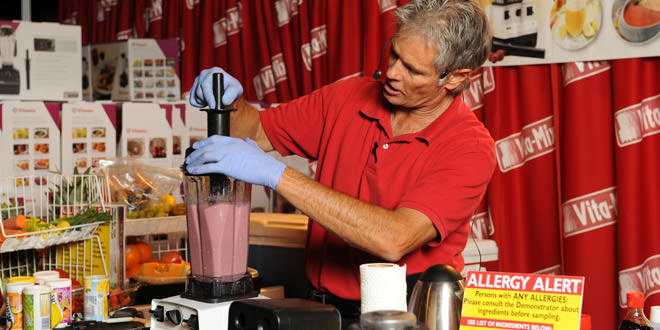 In several of the exhibit halls, informercial pros demonstrate knives and blenders and shower heads and mops and vacuums and ladders. These guys are good. I mean, can your blender make soup?
The Farm Children are Inspiring
 It does my heart good to see the little boys from Texas farms tend their donkeys and cows and pigs and goats and sheep. Little boys with blue jeans and flannel shirts and cowboy hats who look exactly like their tall fathers beside them. I'm glad that world still exists and seeing those farm families makes me proud to be an American. Really.
What About You?
If you've been thinking about visiting Dallas, you should plan a visit during the Texas State Fair, which runs for 3 weeks every September and October. The weather will be gorgeous and the whole experience is can't miss.If you do visit, Big Tex and I will be waiting for you.
6 months ago....


How To Talk to People Who Are Suffering

"I don't know what to say." When we're confronted with someone who is grieving or in pain, most of us feel inadequate and intimidated. But, grieving, suffering people are all around us, and we need to learn how to appropriately engage with them: ignoring them is not an option. On the first anniversary of the murder of the five Dallas police officers, I thought it would be helpful to briefly offer what I've learned about speaking to people in pain.
It's Not About You
Over a decade ago ago, I was working in youth ministry at a church. One afternoon, the pastor of our church came rushing into my office: "Just got a phone call: so-and-so has killed himself." A high school boy from our church shot himself at home, and his parents had found him. The pastor drove the two of us to to meet the boy's family. I've rarely been so sick with nerves. I was worried that I would say the wrong thing or somehow make the situation worse. In other words, I was only thinking about myself. What I realized after visiting with the bereaved father was that it wasn't about me at all, and to worry about saying the wrong thing or otherwise making the situation worse was selfish and foolish.In this particular example, literally the worst thing that this father could possibly have imagined had just happened; there was nothing I could do that could make the situation worse. But, in any interaction with a grieving or suffering person, your words are not going to fix the situation no matter what you say, and if you worry about what you say or how you'll be perceived, you'll be making it about you, when it's really about the other person anyway. So, remember: it's not about you.Which is not to imply that in those situations you should say whatever crosses your mind.
Resist the Urge to Explain
It's one of those phrases my dad always says that has stuck with me: "Resist the urge to explain." We humans like neat explanations, but one of the problems with pain and suffering is that they are ultimately inexplicable. You and I do not know why that child has cancer or why that couple can't conceive or why those cops were killed. Do not speak about that which you do not know. What I mean is that we should not resort to greeting card pablum along the lines of:"Everything happens for a reason;"or"I guess God just wanted another angel;"or"God knew you could handle it."Those sorts of statements are not helpful to people who are grieving or suffering. Resist the urge to explain that person's suffering to him or her. When you do that what you are really doing is making the interaction about you, exactly what I warned against above. There isn't a neat, clean explanation for suffering, and since there isn't,?resist the urge to explain.
Don't Compare Sufferings
In the same way that you should resist the urge to explain, you should also resist the urge to compare sufferings with the other person. You don't know exactly what the person is going through, and it's unhelpfully self-centered to think that you do. It's okay to reference your own experience with suffering, but be sure to refrain from assuming that your situation is comparable to the other person's (even if it seems to be, from your point of view).
Say "I'm So Sorry"
Rather than trying to compare sufferings, I've learned that it's better to instead share 3 simple words with people who are grieving: "I'm so sorry." That sentiment is always appropriate and has the virtue of being true and normal.
Be Normal
Normal people smile when they greet each other and when they say goodbye. Normal people talk about things in specifics. I've found that many people are worried if they should smile or mention the source of the pain when they interact with someone who is suffering, but remember: it's not about you, and you're not going to make it worse. (It's already terrible.) Treat the grieving person as you would any other normal person. This means it's important to give the other person the courtesy of a smile (even if it's a sad smile) and a courteous, friendly look when you greet him or her, and I think it's important to specifically mention the source of the pain. When parents have just lost a child, it's okay to say, "I'm so sorry for your loss." It's okay to say to your co-worker, "I heard about the death of your mother and I wanted you to know I'm really sorry to hear that." I've heard people say that one of the ugly parts of grief is that you feel like such a leper--everyone avoids talking to you about your loss or tries to change the subject. When talking to someone who is grieving, therefore, just be normal.
Pray
It's normal to want to remove someone's pain and it's normal to want to pray. However, when someone is hurting, prayer isn't going to change the source of that person's pain--what's happened has already happened. What prayer can do is change that person's future. When someone loses a loved one, for example, you can't pray that the loss goes away--it's a real, permanent loss. Rather, what you can pray is for God is be with that person in the midst of his or her pain. I've found that it's helpful to pray a version of 2 Corinthians 4:8-9:
?We are hard pressed on every side, but not crushed; perplexed, but not in despair; ?persecuted, but not abandoned; struck down, but not destroyed.
When I pray for someone who has lost a loved one, for example, I'll say:
Lord, this person is hard pressed on every side; let her not be crushed;This person is perplexed at this inexplicable event; let her not be driven to despair;This person is feeling persecuted; let her know that she's not abandoned;This person is feeling struck down; let this grief not destroy her.
Suffering is All Around Us
Suffering is a part of life and no one is exempt. One of the ugly parts of pain is that it makes you feel alone. But, there can be a solidarity in suffering, as we reach out with kindness and courtesy to others as they suffer, and when they in turn do the same to us. I hope the thoughts above are helpful to you the next time you find yourself confronted with a person in pain.
I'm in the midst of overhauling my blog design. If you haven't already signed up to receive updates from me, would you consider doing so here?
Brief Reflections on Fatherhood

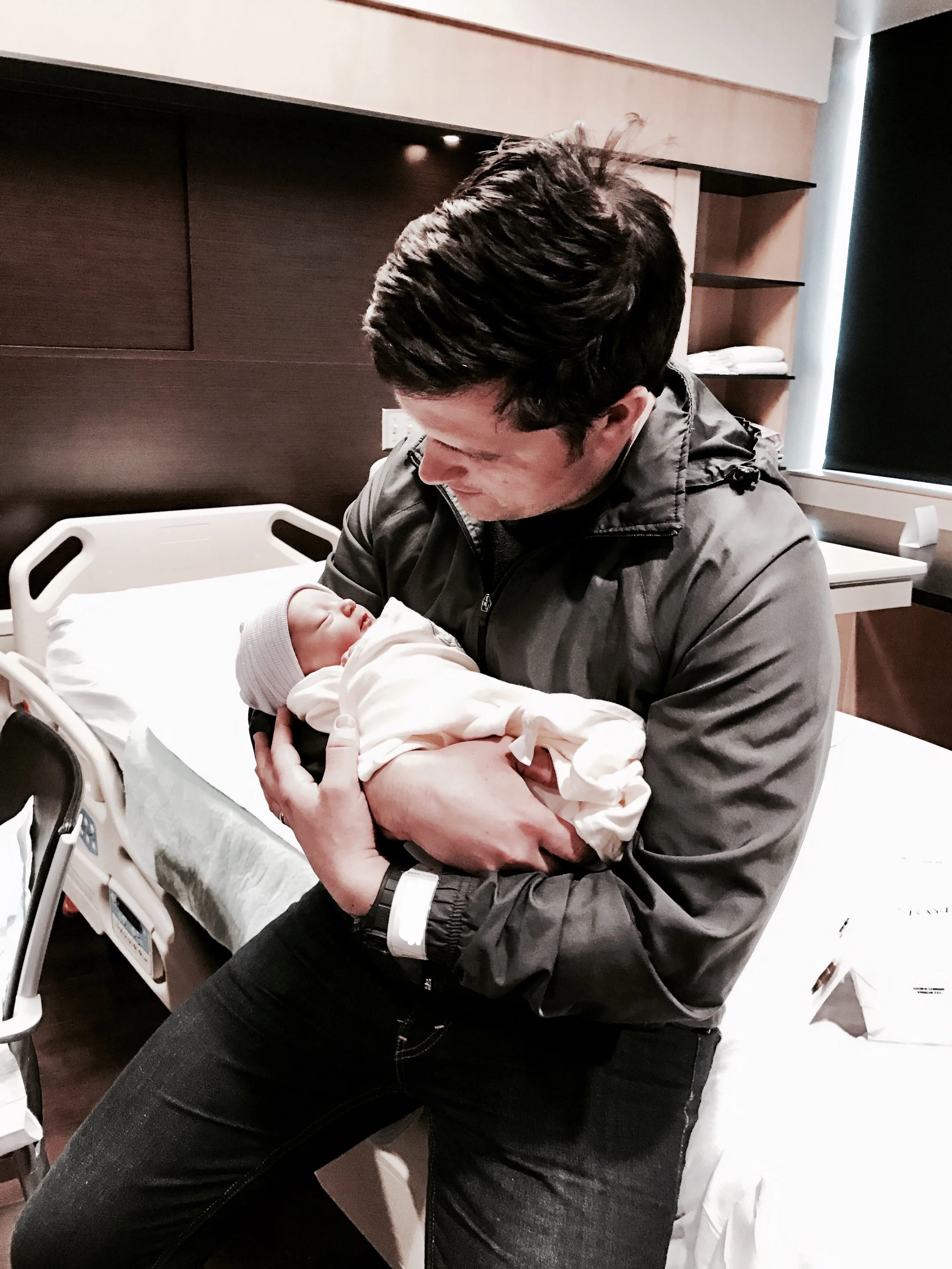
Fatherhood is a stewardship. The Lord gives us the blessing of children, but also the responsibility for them: to teach them to love him and his world. My children are under my care, and my job is to cultivate Christ-like character in them and to help them see the world clearly and learn to investigate it with curiosity?it‘s such beautiful world, charged with the grandeur of God.? It‘s easy to become distracted by everything else, so I need to be constantly reminded that nothing I will ever do will be more eternally important than raising my children to love the Lord their God with all their heart and all their soul and all their strength (Deuteronomy 6). And, of course, the surest way for me to do that is to draw near to the Lord myself; I can‘t teach what I'm not first receiving.It says in the scriptures that we love because God first loved us? (1 John 4:19). This means that any true love I have for my children will be a sharing in the love I receive from God who loved me and gave himself for me? (Galatians 2:20). Too many times we earthly fathers try to love out of a sense of emotion or duty, and though emotion and duty are good things, they will not be enough to sustain me as a father over time. To depend as a father on emotion or duty alone would be like trying to exhale and then exhale again, without ever breathing in fresh air. It‘s when I am receiving and abiding in the love of God that I am able to share that love with my children. I love my children, because God first loved me.For me to know what a father is like, I need to look to my Heavenly Father, and there I see a God who so loves the world that he sacrifices for it. This means that fatherhood requires sacrifice: I learn to give my life to the Lord and to die to myself, and then the Lord can use me to love my children in the way they most need. And, in the beautiful mystery of the gospel, it‘s in the giving of my life that I gain it back, in ways that exceed what I can ask or imagine. In this way, therefore, fatherhood becomes exceedingly joyful: I think I am serving my kids, but in the serving I find myself blessed beyond measure.Fatherhood is a stewardship, and I'm accountable.? But the Lord who blesses us with children is a good God, and he will also bless us with the love we need to be fathers. God wants us to succeed as fathers and wants to say to us Well done, good and faithful servant.
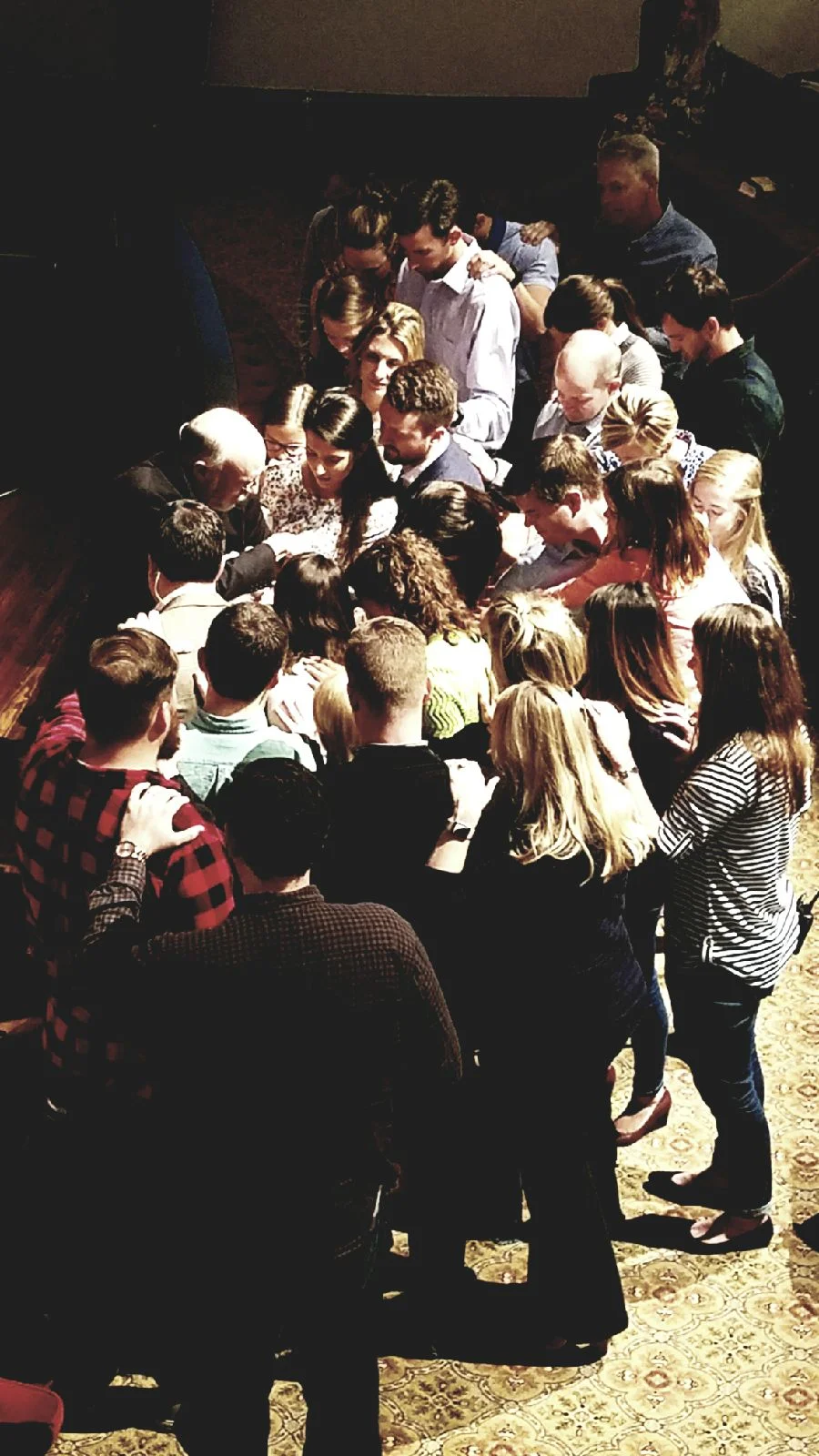
For This Child I Prayed

I prayed for my little daughter for more years‘than I've prayed for anything else in my life. What I'm reflecting on‘tonight is that not only is she an answer to my prayers, but also an answer to the prayers of so many other people. And I'm grateful.
"For This Child I Prayed"
My wife and I have been married for 10 years, and if it had been up to us we'd have had a whole baseball team of kids by now. But, that wasn't God's plan for us. Rather, God's plan for us involved a great crowd of people, praying and interceding for us for years.The picture above was taken on the day of my daughter's baptism, last Sunday. My dad baptized her; our?family, our‘staff, and our small group stood up with us. I love the image of all of them praying for us, because I know that's what they've been doing, and I love it that you can't even see our little girl: she's literally covered in prayer.Just tonight, we received a note from someone in our church who said she'd been praying for us for years--I've frequently heard that these past 8 weeks, and it makes me so happy. In the Scriptures, Hannah prays for years for a child, and when he comes, she triumphantly tells old Eli, the priest: "for this child I prayed."My wife and I could say the same, but we'd have to also add, "And so did countless other people."
Click?here‘to subscribe to updates from me.

Survivor's Guilt? Never Again

Exactly four weeks ago my wife coded after the birth of our daughter and was revived. She had a harrowing few days in the ICU, but after a week in the hospital she was discharged. She was weak, but she was well. And I felt guilty about it.
Survivor's Guilt
I felt guilty because everything turned out okay for my family, but I know lots of people whose situations are not okay.Why am I so blessed?Folks would ask me how my wife was doing and I would truthfully answer, "I think she's going to be fine." And I felt badly about that; I was embarrassed by our good fortune.It's embarrassing how blessed I am:
- other pastors have congregations who hate them; our people dote on us;
- other husbands struggle in their marriages; my wife is the kindest, sweetest woman I know;
- other people's kids have chronic illnesses; my kids are healthy;
- I am a rich, white, American man born in the 2nd half of the 20th century. I wasn't born black in the 18th century or a Russian serf in the 19th century or a Samaritan woman in the 1st century;
- My parents will have been married for 40 years this year and taught me to love Jesus;
- I'm even a great whistler....
- etc.
I could go on, but it's embarrassing: I don't deserve my good fortune. As a pastor, I have the privilege of walking alongside people in every aspect of their lives, cradle to grave, and I know how much people suffer. I've lived in Africa and I've traveled and read widely, and I know how difficult life is for so many people. I know how often it seems prayers are not answered.And so, after my wife got out of the hospital the first time, I felt guilty at our good fortune.And then Wednesday night happened.
Never Again
My wife had to be rushed to the Emergency Room on Wednesday evening, and ultimately had to have emergency and life-saving surgery, surgery that lasted all night. All night I sat in the empty waiting room, and I didn't know if she was going to survive. When I learned she would survive, I also learned that she was intubated and on a ventilator, and then I saw her.Pray to God you never see a loved one on a ventilator, going in and out of consciousness, pulling at her tube with her bandaged hands.I've spent a fair amount of time in hospitals, but when it's your wife there in the ICU, it's almost unendurable.The next night we had another scare and I was woken up on the pull-out couch with bright lights and saw a crowd of doctors in our room. It was then that I decided that I will never, ever again feel survivor's guilt.Survivor's guilt is a selfish indulgence--a luxury--that I want to forgo forever.When you are at a point of desperation, when a leaden dread comes upon you, when that of which you are most afraid is threatening to happen, you become painfully aware how foolish and selfish is survivor's guilt. You think back to the times when you weren't afraid and everything was well, and you're ashamed that you were ever ashamed of your good fortune. And in those moments, you would do anything to get back to the times when things were good.I don't know why God seems to answer some prayers and not others. I don't know why some of us receive the blessings we do. But I also know that I don't deserve my blessings and didn't earn them--they just came on me, like the rain. My blessings don't mean anything about me: all they do is point to their Source and Giver.Rather than feeling guilty, I want to be grateful.I am grateful for God's goodness toward me. I am grateful that I did not have to come home in the dark on Thursday morning and wake up my little son and tell him his mother died. I am grateful that my wife survived. And I'm grateful that I brought her home not one hour ago.I want gratitude to pour out of me. I just went to CVS to pick up a prescription and when the cashier asked me how I was doing, I looked her in the eyes and said, "I am so blessed: my wife just got discharged from the hospital." And I gave her a big smile.I don't deserve my blessings--and I have SO MANY--but I can use them to bless others.I want to be grateful, and because I'm grateful, I want to be a giver.Survivor's guilt? Never again.
Click here to subscribe to irregular updates from me. I have more to say about what I've been learning from my wife's recent proximity to death and our time in the hospital.

In Sickness & In Health: 10 Years of Marriage

Today is my tenth wedding anniversary. It's also been 10 days since my wife coded and was revived in the hospital shortly after the birth of our 2nd child. So, I've been thinking a bit about marriage today. Some years ago, Dr. Paul Brand wrote a book about what he called?"The Gift Nobody Wants." The book was about pain. Dr. Brand was a medical missionary for years and he treated patients with leprosy. Without pain, lepers are unable to know something is wrong. No one wants pain, but it has a purpose.If ever there were a culture totally unsuited for enduring pain it is ours. For most of us, the highest good to be achieved is the avoidance of pain. We spend our days amusing ourselves to death, popping pills and seeking diagnoses, jumping in and out of bed and in and out of marriages, all with the end of minimizing pain and maximizing comfort.Pain cannot ultimately be avoided, however. You can numb yourself with opiates, but the pain in your soul will only increase. The brief physical pain that comes from dental surgery can be palliated, but soul pain must be endured. Which brings me to marriage.On my wedding day I said:"Better...Richer...Health."Everyone likes those words; those words are why we want to be married in the first place.But the vows I said on my wedding day also include the antitheses of those words:"For better,?for worse, for richer,?for poorer,?in sickness?and in health...."How wise of our ancestors to include in the wedding service the words that nobody wants.Nobody wants worse or poorer or sickness, and yet marriage includes those words, too. Marriage, like all of life, includes pain. It's the gift nobody wants.Last week in the middle of the night, I leaned over my wife's bed in her ICU room and used a straw to drip drops of water on her parched tongue as she looked at me with eyes wild with pain and fear. Drop. Pause. Drop. Pause. At that moment I was afraid she was going to die, but at that moment?I also felt that I was closer to being her husband than any previous moment in our 10 years of married life together.Pain is the gift nobody wants, and I'm wondering if pain is not also the primary gift?of marriage.Don't misunderstand: my wife and I rarely fight and our first 10 years of marriage have been exceedingly happy. What I mean is that marriage has a way of confronting you with pain. One day of course, there will be the pain of death and the loneliness of being left behind, alone. There will be the pain of seeing the other suffer throughout your married life together, in small and great ways. And, most importantly, there is the pain of being confronted with your own selfishness. This last pain, I believe, is the primary gift?of marriage.Tim Keller says somewhere that selfishness is the cause of all marital problems. I believe, though, that selfishness is why God calls a man and a woman together into a marriage--to?use the husband to confront his wife's selfishness, and vice versa. When you are married, you are constantly discovering that your heart is much more selfish than you'd previously understood. Men and women are different, and the effect of bringing a man and a woman together into marriage is friction. It's pain.That pain is the gift nobody wants.And yet it's the pain we need if we are going to become the creatures God created us to be. If there were another way for us to become holy apart from pain, we'd have discovered it centuries ago. But there isn't.No one chooses pain. Some people are physically courageous and will endure physical pain, but the deepest pain is spiritual pain, and spiritual pain breaks everyone. A?boxer?might step into the ring year after year; he can stand the pain of getting his nose broken over and over again, but not the pain that comes when two sinful people are joined together in marriage.The pain that comes from marriage is a searing pain: it hurts to know that you are not as good as you want to believe, that you yourself caused your wife pain with a petulant remark or hard heart that chooses not to forgive. Sin burns.It's not surprising that a culture that sees avoidance of pain as the highest good will struggle with marriage. This is?why the Christian story?of marriage is so countercultural. Marriage, the church has always taught, is not a contract to terminate as either party desires, but a covenantal promise that includes better and worse, richer and poorer, in sickness and in health. And it's when we endure the worse, the poorer, and the sickness that we can become wise and good.I don't want pain. I don't want the pain of watching my wife's vital signs taper off, and I don't want the pain of being confronted with my own selfishness and sin in the daily work of marriage. And yet I know that pain is a gift, even if it's the gift nobody wants, and I'm grateful.
?Click?here‘to subscribe to irregular updates from me.

What NOT To Do For Your Country

Tomorrow, a new president will take the oath of office. Whether you voted for President Trump or not, there are lots of people who are telling you what you should be doing for your country, either in support of his policies or in opposition to them: folks are telling you to register voters or call congress or attend a protest or donate to a cause or pray for a candidate. All of those actions might be important, but they are not most important. In fact, I believe the most important thing you can do for your country is not to do anything. Let me explain.
Character is Destiny
The ancient Greek philosopher Heraclitus believed that character is destiny. What he meant is that who you are will inevitably determine what you do. A brave man will act bravely, a dishonest man will act dishonestly, etc.Jesus said the same thing in the Sermon on the Mount: Do people pick grapes from thornbushes, or figs from thistles? Likewise, every good tree bears good fruit, but a bad tree bears bad fruit. A good tree cannot bear bad fruit, and a bad tree cannot bear good fruit? (Matthew 7:16-18).The English word character has roots in the Greek word for engraving. You might say that character is etched into a person; it is something foundational to who the person is.
Formation vs. Education
In our culture, we tend to overlook the slow importance of character formation and instead prefer the quicker and easier work of intellectual education. Our leaders talk about improving education and argue about how best to do that, but I cannot recall a public figure who has recently been talking about the best way to form character in our children. Education is important, but education without character will be useless at best and dangerous at worst. Character matters.One of the major themes of the New Testament is about how a follower of Jesus can become Christlike in character. The reason the New Testament is so concerned with character change is because the early Christians knew that you can‘t actually live like Jesus unless you are being changed like Jesus from the inside out. Only then?with a mind transformed and renewed? (Romans 12:1-2)?is Christlike living possible. It is not possible to love your enemies, e.g., without first becoming the kind of person who loves her enemies.The moralistic instruction that we are constantly given?be more civicly engaged, reach out to your neighbor, call your congressman, pray for your senator, start a movement?is all good advice, but it is given out of order. Before you start a movement, you first need to be the kind of person who starts a movement; before you pray for your senator, you first need to become the kind of person who prays for her senator. Character matters. Good trees produce good fruit.This is why I believe the most important thing you can do for America as our new president assumes office is not to do anything. Rather, you should focus on becoming.So, how is character formed?? How can we become the kind of people who do good things, or to use Jesus? metaphor, the kind of trees that produce good fruit?
Silence and Scripture
I believe the most effective way to become more like Jesus is to spend the first 15 minutes every morning in silence and scripture. Before you reach for your phone or check your Instagram feed or see who won the late game, you need to just sit and be still and read a bit of Scripture. Taken by itself, the principle of the #First15 seems useless: how does sitting in silence result in any new voters registered or any new movements funded or any congresswomen prayed for?? But becoming the right type of person will result in your doing the right type of actions, and on a daily basis nothing will be more formative to your character than the #First15.Character is destiny: good trees produce good fruit, and bad trees produce bad fruit. Who you are determines what you do. There is a lot that needs doing in America, but doing comes after being. If you become more like Jesus, you?ll inevitably act like him. (In fact, the more you become like Jesus, the more Christlike actions will be second nature to you.)? This is what the early Christians meant by discipleship.It was fifty-six years ago that President Kennedy delivered that thrilling conclusion to his Inaugural Address: Ask not what your country can do for you, but what you can do for your country.? As a new President assumes office, I believe that what‘s most important for you to do for your country is to be a certain sort of person: someone who thinks and acts like Jesus.
I value clarity and curiosity. What about you? Click here to subscribe.

My One Word for 2017

As I've done for the past three New Year's Days, today I'm choosing a one word theme to live into for the coming year. I've made goals for 2017, too, but there's something I like about the simplicity of choosing just one word to knit all my goals together.
My One Word for 2017
For 2017 I'm again choosing the same word I've chosen for the past three years.My one word for 2017 is early.I will:
- wake early
- pray early
- workout early
- arrive early
- get things done early
- finish my sermon early
- get to bed early
What about you? What‘s your one word for 2017? Why?
P.S. Fox and Hedgehog
The Philosopher Isaiah Berlin, drawing on a line from the Ancient Greek poet Achilocus, wrote a famous essay in 1953 entitled The Hedgehog and the Fox. The basic idea is that the fox knows many things, but the hedgehog knows one big thing. Foxes have a variety of interests; hedgehogs have one stubborn idea.In this space, I follow my interest wherever it takes me (like a fox) while always writing in the service of The One Big Thing (like a hedgehog).What‘s that One Big Thing? You?ll have to read to find out.Click here to subscribe and get my posts delivered straight to your inbox.

Read the Bible With Me in 2017

Can I suggest a New Year's resolution for you? Make the commitment to read through the Bible with me in 2017. At Munger, 2017 is our Year of the Bible, and we're launching something called The Bible Project. Here are 3 reasons why I hope you'll join me in?reading through the Bible in 2017.
The Bible is Difficult to Read Alone
Lots of folks struggle to understand the Bible, which shouldn't be surprising: the Bible is a collection of ancient documents, written by strange people in strange languages--of course it's difficult to read and understand all by yourself. Through the Bible Project (we've taken the name from some folks in Portland with whom we're partnering), however, we'll be updating our blog?every day with explanatory notes, videos, charts, etc. To give you an example of the kind of resources available, check out this great intro video to the Book of Genesis:[embed]https://www.youtube.com/watch?v=KOUV7mWDI34&index=1&list=PLH0Szn1yYNee8aedW_5aCpnzkxnV7VQ3K[/embed]The Bible is difficult to read alone--so don't. Read along with me.
The Last Time You Tried It, You Quit in February
Many of you have probably tried to read through the Bible in a year, only to abandon your resolution in February when you got to Leviticus (if you made it that far). You're much more likely to complete marathon training in a group, and in the same way you're much more likely to read through the Bible along with other people. I'm preaching through the Bible in 2017, we'll have a weekly Bible study, a daily blog, podcasts, etc. All these resources are to help you persevere. Good things come to those who persevere.
Nothing Has More Potential to Change Your Life
I guarantee you that 2017 holds unexpected challenges for you. How will you prepare? There is nothing you can do that will have greater potential to change your life and prepare you for the future than the daily discipline of spending time in silence and scripture.
So, Here's What to Do
If you are a Mungarian, pick up one of the?free One Year Bibles we're handing out at church; if you don't live in Dallas, get one of these from Amazon. (We're using the ESV translation, but they are currently out of print.) You could also use the Bible app on your smart phone and pick the One Year Bible reading plan, but I recommend using the hard copy.Follow along with our blog: bibleproject.mungerplace.org.Watch my sermons: http://www.mungerplace.org/sermon-library/.Start on Sunday morning.Of all the New Year's resolutions you could make, reading through the Bible is the most important.So, are you in?
The fox knows many things;The hedgehog knows one big thing.Click?here‘to subscribe to regular updates from this blog.